Building My Own Slats - Spacing Questions

Hi folks,

I joined planning on researching a new mattress, but as I got into my “new slats” project I realized I could ask y’all about this, too.

I currently have an Ikea MALM bed, which I am generally happy with. However, about a year ago, the original thick, flat slats gave out. I replaced them with the Ikea LUROY, which aren’t working for me. As you can see from the image on the product page, they are thin, flimsy, and convex in the middle. I am a big guy and I sleep in the middle of my bed, which means that the mattress has rapidly begun to sag since installing these.

Realistically I also need a new mattress soon, but I am hoping I can buy a little more time by replacing the slats, and I don’t see a reason to spend a bunch of money on fancy slats when I can do most of the work myself. I’ll also want nicer slats when I get another mattress so this doesn’t happen again.

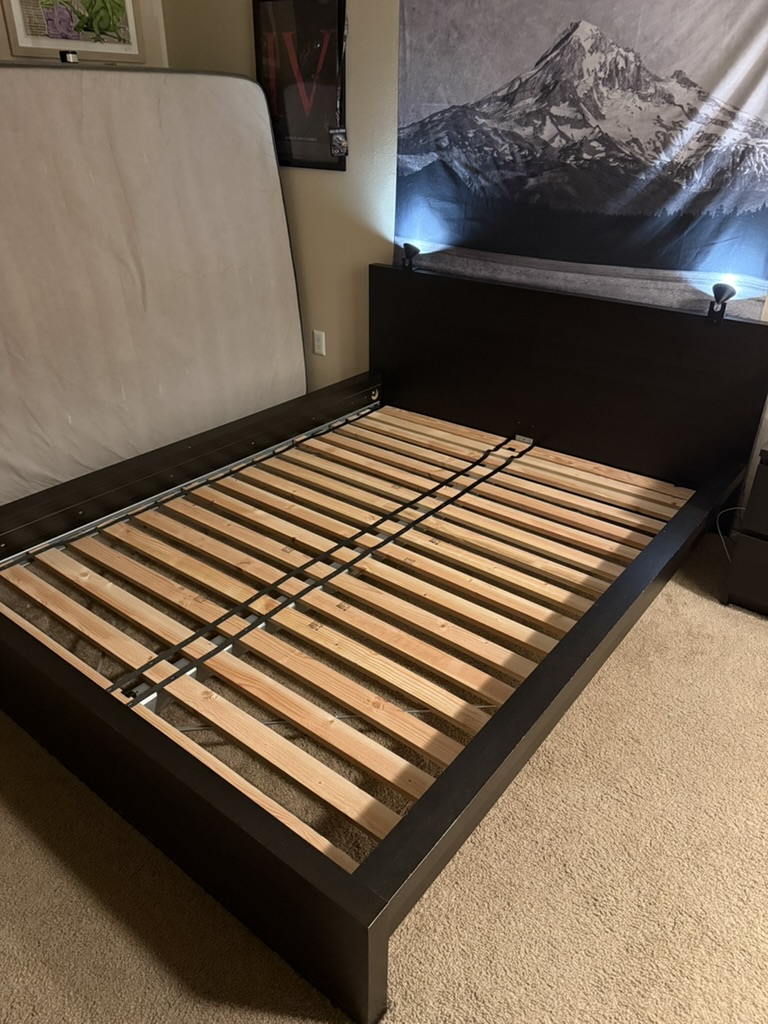
So. The interior of the MALM is 80", and there are retaining pegs for the slats at each corner 4" in. My thinking is that I can get two 1x4s for the head and foot of the bed (bringing the total down to 72"), and then eleven 1x3s, spaced 3" apart (66" with an additional 3" each way between the head and the foot of the bed), for the remaining slats.

Is this suitable? Should I use 1x2s instead of 1x3s? Is the 3" spacing okay? What do y’all think?

Cheers, I’ll come back to ask about mattresses once I’ve solved this puzzle. :slight_smile:

@MattressFoundations

1 Like

Hi there — you’re diagnosing the problem correctly, and you’re definitely not alone with the MALM + LURÖY issue.
What’s failing you isn’t really the MALM frame — it’s the thin, bowed LURÖY slats. They flex by design, and when you combine that with center sleeping and a higher body weight, the result is exactly what you’re seeing: accelerated mattress sag and poor spinal support.
Your DIY slat idea (quick reality check)
Your plan to replace them with flat lumber is a solid upgrade over LURÖY:
1x3s are the right choice over 1x2s — more surface area, less flex
3" spacing is acceptable, though it’s right at the edge of what most mattresses tolerate long-term
Flat, rigid boards will immediately reduce the “hammock” effect you’re feeling
That said, once people go down this road, they often realize they’re trying to engineer something that already exists — and has been tested for durability, weight, and mattress longevity.
A solution that eliminates the guesswork
If you want to fix this once and protect both your current mattress and your next one, the most suitable foundation in the U.S. is the Terra Foundation from Mattress Foundations.
Why it works so well for your exact situation:
1.6" slat spacing — dramatically tighter than IKEA or most DIY builds
Thick, solid hardwood slats — no bowing, no flex, no center collapse
Even weight distribution — sleeping in the middle is no longer a weak point
Tool-light assembly — easy to set up and take apart when you move
It drops right into platform beds like the MALM and avoids the trial-and-error of custom slats.
One more thing worth knowing: incline sleeping
Since you mentioned you’re a larger sleeper and noticing discomfort and sag, there’s another angle that’s often overlooked — incline sleeping.
A gentle full-body incline (not just the upper torso) has been shown to help many people with issues commonly reported by center sleepers and heavier individuals, including:
Reduced pressure on the lower back and hips
Improved circulation and reduced fluid pooling
Less reflux and nighttime congestion
More consistent spinal alignment when paired with a rigid foundation
The key is that the entire bed is inclined uniformly — not wedges or adjustable bends — and it must sit on a strong, flat, closely spaced foundation to work properly. This is another reason rigid platforms like Terra are so effective.
Even a modest incline can noticeably improve comfort and morning stiffness for the exact type of sleeper you described.
Bottom line
Your DIY plan will absolutely outperform LURÖY — but if your goals are:
preventing mattress sag,
improving long-term comfort,
supporting a heavier sleeper properly,
and keeping future options like incline sleeping open,
then a rigid, flat foundation with tight 1.6" spacing is the most reliable fix.
You’re doing the smart thing by addressing the support system first. Once that’s right, mattress decisions become far easier — and far less expensive over time.
Happy to help whenever you’re ready to talk mattresses :waving_hand:

1 Like

if I wanted ChatGPT’s response, I would have asked ChatGPT. I have no idea why @NikkiTMU edited my post to tag you. Perhaps I have posted in the wrong forum or am otherwise missing something.

1 Like

What precisely is the question you’re asking?

It looks like the mattress foundation company already addressed the issue, but their answer wasn’t what you were looking for. They are specialists in foundation construction, so their perspective makes sense, even if you don’t want a commercial solution.

If the goal is a DIY fix that works with any future mattress (foam, hybrid, or innerspring), I’d recommend tightening the slat spacing further. 1.75"–2 spacing eliminates compatibility concerns entirely and significantly reduces long-term sag resulting from potential foundational issues.

Your idea of bypassing the pegs set 4" in is sound. Where I disagree is the 3" spacing, it’s workable, but it’s right on the edge, especially for a heavier, center-sleeping load. What I dont see on that MALM bed is any center support legs. As a larger person, you would be better served adding some. It appears that there is an option for draws under the bed and it is not clear if those draws are the full one half the width of the bed, which I doubt, so adding center support legs if there are none, is a smart move.

As a bigger sleeper, thicker and wider slats are also to your advantage. They resist deflection better, distribute weight more evenly, and will hold up far longer than narrow stock under concentrated center load.

Narrower spacing combined with stiffer, wider slats is the more durable long-term solution. You may even want to do a 1.25 x 3 as 1x3’s are often only 3/4" in actual thickness.

The bottom line is, you should spend a little extra now, as this DIY project just went from budget to probably more than what you want to spend, but there is a right way to do this and the short cut. Do it the right way and you will not be worrying about it later.

Maverick

2 Likes

Thanks - there aren’t center support “legs,” but there is a central steel beam running the length of the center of the bed which is anchored to the top and bottom and then reinforced by steel railings running along the edges and diagonals. I also have two support legs under the steel beam. This has served me well since I bought the bed in the early 2010s, and the issue only started when I ended up with the curved slats combined with the age of the mattress.

Noted on the spacing, though - I have ordered some new hardware just to refresh everything (ikea sends spare hardware for free) and it looks like they’ve revised the bits that retain the slats, so I’ll wait to see what those look like before crunching the numbers again but I will shoot for 2" spacing or so.

As it stands, the cost of two 1x4s and 12 1x3s cut to size at my local lumber yard is just under forty bucks, so I’m still coming in well under the cost of any off-the-shelf solution that I can find.

My frustration with the previous response is that if I put my original post into ChatGPT and tell it to pitch me the Terra Foundation from Mattress Foundations as an alternative to doing it myself, it spits that exact post out nearly word-for-word. I came here because I wanted to speak to people and get their insights, not have a company use ChatGPT to try to sell me their product. I was also confused and annoyed by the fact that, as far as I could tell, a moderator had edited my post to tag the company beforehand, but that could just be a difference in my understanding of forum etiquette as this has now happened in my other posts as well.

Oh well. Regardless, I sincerely appreciate you taking the time to respond and answer my questions. Thanks!

1 Like

Best of luck to you! As a bigger guy, when you upgrade to the 1x3 mattress, a slightly thicker option might still be better, especially since it does not seem to be a significant cost increase right now. Even though your foundation sounds supportive based on your description, having someone video you getting onto the mattress and resting for 10–15 minutes is still a useful way to check for any flexing and ensure ultimate comfort.

For reference, moderators may add a tag when they feel a Trusted Member with expertise in a particular area is best suited to answer a specific question. That said, I completely understand your perspective. At the end of the day, we are all here to help and provide the best advice for each individual’s situation.
Wishing you all the best for your project.

Maverick

1 Like

totally, every forum’s different and I’m not trying to tell anyone how to do their job, I was just surprised!

And understood regarding the 1.25" slats vs the 1" (or, in fact, 3/4") - I will make sure that the slats are at least 1" thick, if not 1.25" since you are correct that I will be hunting for a new mattress in the near future (as per my other thread) and it’ll be nice to have some extra insurance when I start bulking up for competition again.

Cheers!

1 Like

Pretty much nailed it. Didn’t have an easy way to take an extra half inch of space at the bottom into account caused by the retaining pegs, so the bottom 1x4 and the first 1x3 are 2.5" apart and then the top 1x4 and 1x3 are 1.5" apart as a result, but other than that I’m pretty happy with it for my first attempt. MASSIVE difference in support, the “dip” in the mattress is gone (I probably could have kept the old mattress going a bit longer if I’d done this first, but oh well, the new one’s already on the truck for delivery).

Total cost $62 and about an hour of work. Not bad.

1 Like

That is awesome, what a great success story.

Use it in good health!

Looks great, good job

1 Like