I had an Ikea Morgongava (now discontinued), which was an 8" 85% natural latex and 15% synthetic latex mattress that one of my kids hijacked after sleeping on it. It was the best mattress I ever slept on. I’m ready to replace my current Brooklyn coil mattress and my head is spinning from all the research I’ve done.
I was leaning toward Sleep on Latex since it seemed to be the closest to my beloved Ikea, but then I got lost in reading reviews and started looking at hybrid Latex mattresses. At this point, I am thoroughly confused.
About me: I start the night on my back but move around a lot, sleeping equally on my side and stomach. I sleep hot (and live in Florida) so cooling is important. I weigh about 140, sleep alone.
Thanks in advance for any recommendations, tips, etc,
Hi JaxShopper: I think a hybrid mattress is a good choice for you. Choosing a natural hybrid, coils and natural latex as the comfort layer, will give you the cushion you need as well as sleeping cooler than synthetic foams. Given your weight a soft top with a medium gage coil should be a good place to start. One particular hybrid mattress that we carry is the Posh + Lavish Chic. That mattress has done well for sleepers of your size. There are members of this forum that build natural hybrid mattresses that could also fit your needs. If there is a natural bed store in your area try out some mattresses and if you have any specific questions come back here to the forum and we can help dial in your comfort needs.
Hi JaxShopper, full disclosure, I’m with Sleeping Organic so weigh this accordingly.
Dennis makes a fair case for a hybrid, but since the bed you actually loved was all latex, I would not rule that category out on cooling grounds. A latex bed under a breathable wool and cotton cover handles heat well for most people, and the cover does a lot of that work. Coils do move more air, so if you have run genuinely hot on every bed you have owned, that is a real argument for the hybrid. If the Morgongava never slept hot on you, that tells you more than any spec sheet will.
On firmness, the useful thing at 140 lbs is that you are light enough that “medium” on most websites will feel firmer to you than it does to the person who wrote the description. Your side sleeping wants the top layer soft enough to let a shoulder in. Your stomach sleeping wants the hips held up. Those pull in opposite directions and that is the whole problem to solve.
For reference, our own scale runs X-Soft 14-19 ILD, Soft 19-22, Medium 30-32, Firm 37-40, X-Firm 44. At your weight I would expect a Soft Talalay comfort layer over a firmer Dunlop support core to be the starting point, not a medium on top. Talalay tends to cradle, Dunlop tends to hold, and you want the first thing under your shoulder to be the cradling one.
Sleep on Latex is a perfectly good straightforward option if you would rather not think about layers at all. Where a configurable bed helps someone in your position is that back, side and stomach in one night is exactly the case nobody gets right first time. Ours lets you swap a layer at a discount inside the first year if the first guess is off, and you keep the original layer. Worth asking whoever you buy from what an adjustment costs after you have slept on it, because that answer varies a lot.
That IKEA bed you had, I asked AI about and it said it was a single slab of medium Dunlop with wool batting and a cotton cover. If you have a proper frame setup with wood slats no more than 3" apart you could replicate that bed with a 6-8" medium layer of Dunlop with a bamboo mattress cover from @Arizona_Premium this would be to replicate the IKEA bed. He also sells hybrid options.
If you wanted to add a plush top layer you could always use a wool mattress cover that has a thick top on it, or even a wool topper which is just an even thicker soft top layer. Or you could use a 2" soft latex topper. Extra height with softness is more suited to side sleepers though, not stomach sleepers.
My current favorite build for diy is 8" 15.5g base spring, 3" quadmini spring, and 2" soft latex from @PSS as I like the majority - spring type of build. Or if you want to go with 15.5g coil, 2" medium then 2" soft in a 12" cover, I think that’s another great build. Some like more latex on top, some like less. For reference the standard introductory models for latex mattresses of larger brands will be an 8" coil, with a 2" medium latex and a layer of wool in a cotton cover.
If you really think about it, you can remember how each type of material feels, and get a good idea of how a certain mattress will feel based on the specifications. Through comprehending how things work together, you can decide what you know would work best for you.
Yes, the Ikea bed was pretty basic. It was, after all, a bed from Ikea! And I was verrrry happy with it. I am probably my own worst enemy at this point because the more I read and research, the more confused I become.
I have a platform bed with extra slats (about 1.5" apart) so I am set on that front.
That’s true, there are so many options. I did the same thing before learning about the properties of each material and how they all work together. Think of it like a sandwich; when you know the flavor of each layer, you get an idea of how the end result will taste. Though still the order of each layer is going to affect the experience of eating the sandwich even with the same ingredients.
The standard philosophy to help with simplification is this: soft on top for pressure relief, and supportive underneath. Then it’s up to the sleeper to feel the bed and decide what level of each is needed, and what level of softness and design they prefer for the top of the mattress.
A single tall slab of medium Dunlop can work because it has a higher support gradient. When you press into latex, it has the highest level of energy return, so it’s building firmness as it’s compressed.
Springs have a more balanced gradient, so they maintain whatever firmness they are throughout compression giving a slower to respond less reactive feel than latex. They still are very responsive.
Polyfoam is a little less responsive than springs, use of polyfoam will “settle” the feel of a bed a little depending on the percentage of the final build that’s composed of it.
Then there’s memory foam. Memory foam settles down the responsiveness of the layers around it the most. If you like to feel “settled in” to a bed more with a slower feel, you’ll want more of your bed to be composed of this.
It’s like saying “you are what you eat”. That statement seems overly simple, yet also not that simple when you learn how everything works. Eventually you come full circle and realize it really is simple in an unexpected, all-encompassing way.
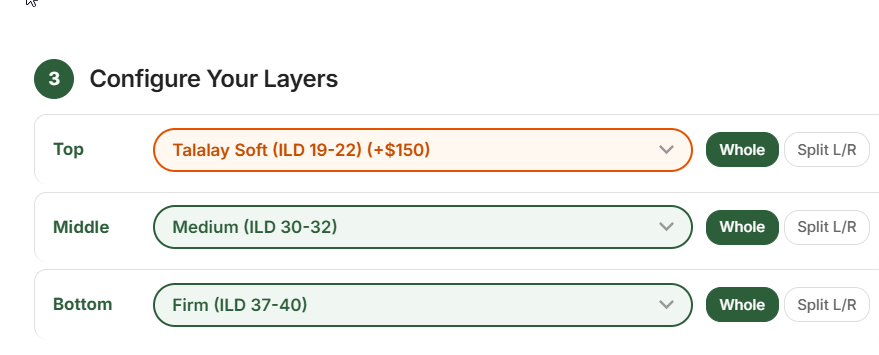
One check on your screenshot: the +$150 shows only on your top layer, which means your middle and bottom are on the standard GOLS Dunlop. That is the combination I meant. Talalay on top to cradle the shoulder, Dunlop underneath to hold the hips up. Putting Talalay on all three would lose most of the point of it.
You can also ignore the Split L/R toggles. Those are for two people who need different firmness on each side. Sleeping alone, Whole is right on all three.
The honest caveat, and it is specific to you: a soft top is correct for your side sleeping, but stomach sleeping is the thing a soft top can get wrong. If you wake up with a dull ache low in your back, that is your hips sinking into the top layer rather than the bed being defective. It is the most likely what this first configuration misses, and also the cheapest thing to fix, because it is one layer rather than a mattress.
On the slats at 1.5 inches, you are already set. Latex wants continuous even support underneath and that spacing is well inside what it needs.
Fair warning on feel. Coming off an 8 inch single slab, a three layer build reads as more contoured on top and more supportive underneath. It will not be the Morgongava. For a side sleeping shoulder it should be better, but do not expect night one to feel like the bed you remember.
And Gene’s DIY route is a real option, not a worse one.
I’m thinking I could be happy with a base of Dunlop in a “firm” iteration (I really wish there was some standardization to these terms - very few manufacturers provide ILD numbers and the terms seem to be based on marketing rather than anything objective) that I can add a Talalay topper to if needed.
Just be aware, firm dunlop (say 50 ild) comes across a lot firmer than a layer of firm polyfoam because of how it acts, you might want to go with more of a gradient like organic bedroom listed. But with latex layers there’s always the ability to swap things out or add a topper.
On the standardization point, you are right, and it is the most useful thing anyone has said in this thread. There is no industry-wide firmness standard, and most sites pick an adjective rather than publish a number. So here is ours as a fixed reference you can measure other people’s claims against: X-Soft 14-19 ILD, Soft 19-22, Medium 30-32, Firm 37-40, X-Firm 44.
Which brings me to one gentle correction. Firm Dunlop at 50 ILD is well above anything in our range. I’ve actually never heard of an ILD 50. Our Firm is 37-40 and our X-Firm is 44. If someone quotes you 50 for a “firm” layer, that is worth questioning, because it will feel considerably harder than what most people mean by the word.
Your instinct is sound, though. A firm Dunlop base with a Talalay topper added over it is a perfectly good way to buy, and it is close to what a layered bed is doing anyway. One thing I would flag: at 140 lbs sleeping partly on your side, a firm base with nothing soft above it will be hard on a shoulder from the first night. I would plan for that top layer rather than treat it as a maybe. Buying the base and the comfort layer together, with the ability to reorder or swap them, is the same idea without the waiting.
Whichever route you take, ask for the ILD as a number. If a seller cannot give you one, that itself tells you something.
My personal build is very similar. I’m a 5’8", 155-lb stomach sleeper and like a firm mattress.
I use a 14.75g 8" QuadCoil and a 2" med latex. Using a 2" soft would also be nice for me.
 And I was verrrry happy with it. I am probably my own worst enemy at this point because the more I read and research, the more confused I become.