Seeking Recommendation to Replace Luma Sleep Latex Hybrid

Hello All - First a quick thank you to everyone on the forum for the wealth of knowledge here! After lots of research for past mattresses, I’m finally here with a question for the community.

Current Mattress: Several years back, we purchased a Luma Sleep Hybrid Slumber System queen mattress that we’ve been very happy with. The construction was a foam layer, coils, and a 3” talalay latex topper. We initially ordered the medium firmness, but after a month felt that was too soft and ended up swapping into the firm, which we’ve really liked over the years. For background, I’m 5’9” 215 lbs side sleeper and my wife is 5’8” 130 lbs primarily stomach sleeper. We both really dislike the sinking in feeling of memory foam, so buoyant latex on top has been awesome!

New Mattress Need: Moving into a new house we finally have room for a king mattress, but with Luma Sleep out of business we’re trying to find something with that similar cushioned, but supportive “sleep on top of the bed, not in it” feel.
Based on what we’ve seen in the forums, we’re gravitating toward a couple options:

  • 14” DLX LatexLux Hybrid mattress
  • Going for an all latex 13” with Sleep EZ

Questions on our mind:

  • The DLX LatexLux hybrid looks like a solid option similar to our existing mattress, but the latex layer is Dunlop rather than springier talalay. With Dunlop’s progressive firmness, should we think more about “medium” firmness than the “firm” talalay we have today? Do we lose any of the cushioning feeling with Dunlop? We’re just having trouble deciding how big a deal the Dunlop vs. talalay is in practicality.
  • If we go all latex through SleepEZ, we can have a talalay top layer, but we’re less certain about creating a similar firmness profile with latex throughout vs. our hybrid mattress today. There’s obviously lots of flexibility to dial in firmness with all the layers. The SleepEZ wesbite recommended medium / medium / firm / extra firm based on our details, but I worry about whether the medium top layer will feel too soft like the Luma Sleep medium did at the outset.

If anyone has been in a similar boat, we’d really appreciate any insights! Also we’d welcome any thoughts from @DLX or @Sleep_EZ on how firmness profiles might compare to match the setup we have and like today.

Thanks!
1 Like

Hi Jags73 and welcome to the forums and thanks for the inquiry! Without having laid on that mattress myself, I can’t tell you how to replicate, but I can say that our initial recommendations have a 90% success rate (we only have a 10% layer exchange rate) so there’s a 90% chance that the website’s recommendation turns out to be your perfect setup. On top of that, we only have a 4% return rate for the organic mattress, and the industry average for mattress returns is 15-20 % with some companies as high as 35%, so 96% of our customers find that they love the mattress even if they have to excange or rearrange layers.

Aside fro all that, please note that our mattress covers have an inch of wool in them, and that inch of wool has a big impact on how much you’re able to sink into the latex, giving the mattress more surface tension and a firmer feel. So the cover would make a soft layer feel more like a medium, make a medium feel more like a “medium-firm” and so on. So there’s no reason to think the recommendation would be too soft for you.

1 Like

I appreciate the super quick response and good to know the success rate on the website fitting appears to be solid. The detail on the wool cover is also helpful - we hadn’t accounted for the fact that might add some tension and make a medium feel a bit firmer. Thanks for weighing in (and for all the detail you’ve added in other posts I’ve spent time reading through)!

1 Like

Sure thing! Best of luck on the mattress hunt, just let us know if there’s anything else we can help with!

1 Like

Thanks for all the information. That was very helpful.

Based on what you shared, if you’ve been happy with your Luma Hybrid Slumber System and its separate Talalay topper, we’d actually lean in a slightly different direction.

We’d recommend our Essential 10" paired with a separate Talalay latex topper. We don’t sell toppers ourselves, but companies like SleepEZ are good people and very helpful. We are not affiliated with SleepEZ in any way, but we’ve just had positive experiences with them over the years. You’d be supporting both companies by purchasing the Essential 10" from us and the topper from them. Just don’t forget to order a topper cover as well.

I’d suggest talking with SleepEZ about whether you have a 2" or 3" Firm Talalay topper and confirming the firmness rating of your Talalay.

We believe your Luma used a separate topper rather than integrating the latex into the mattress. If that’s the case, a separate topper creates a different feel because it has more freedom to flex independently, giving a slightly different sensation. We also believe Luma used a very stretchy topper cover, so you were sleeping almost directly on the latex which also contributes to a different feel.

If you can post a photo of your current Luma setup here, we’d be happy to confirm how it’s constructed.

Our Latex Hybrid is a solid choice, but integrating the latex inside the mattress changes the feel somewhat compared to a separate topper. Since you’re trying to recreate something you’ve already found comfortable, I think the Essential plus a Talalay topper gives you the best chance of getting close to that familiar feel.

I hope that helps, and please let me know if you have any questions.

1 Like

Most of what changes here is the loss of a distinct topper-on-coil structure, which creates a very different pressure curve than integrated latex hybrids. Dunlop over coils will feel more grounded and less elastic at the surface compared to Talalay, even when the nominal firmness looks similar, because it engages the support layer earlier and more directly. At this point, the closest equivalents to that type of layered hybrid construction are usually found with smaller hybrid or custom-focused builders rather than standard retail models. Matelas Personnel, DLX, and a few similar manufacturers tend to operate in that space where layering can be more closely replicated. When you were happiest with the Luma setup, was it mainly the reduced sink, or more the consistency of spinal alignment through the night?

I recently bought the luxerion hybrid from latex mattress factory and sounds pretty similar to your old bed. They told me that the king size version of that mattress has a zipper so you should be able to switch out the existing talalay layer for a firm talalay layer. I’m not sure if that would financially make sense as an option, but I figured I’d mention it.

Hey Jags73,
Welcome to the Mattress UnderGround, we are glad you are here and thanks for your question.

I think both DLX and SleepEZ gave you some really practical advice. They’re two of the more knowledgeable and respected manufacturers in the industry, and their responses reflect years of hands-on experience.

What I liked about DLX’s response is that they focused on recreating the feel of the mattress you’ve been happy with, rather than getting too caught up in the technical details or fancy jargon. Those details can certainly be useful, but I’d look at them as clues rather than rules. Since you’ve already spent years sleeping comfortably on a hybrid with a separate Talalay topper, their suggestion to start with a similar design seems like a very logical approach.

I also thought SleepEZ made a great point that often gets overlooked- the mattress cover and the way the mattress is put together can have a surprisingly large impact on how it feels. It’s a good reminder that you can’t judge a mattress by looking at one layer or one material alone.

There’s a lot of discussion about Dunlop vs. Talalay, separate toppers vs. integrated hybrids, and how different constructions behave. Those things certainly matter, but I think it’s easy to get lost in the terminology. For most people, what really matters is whether the mattress gives you the feel you’re looking for.

From your post, you’ve already described that really well, you like the buoyant feel of latex, you don’t like the “stuck in the mattress” feeling of memory foam, and you preferred the firmer Talalay topper because it let you sleep more on the mattress than in it.

To me, those are the most important guideposts. The construction details are simply different ways of trying to achieve that end result. Even if another mattress has similar specifications on paper, it may not feel identical.

If your goal is to stay as close as possible to what you’ve loved for years, I’d probably lean toward the approach that most closely resembles your current setup. If you’re open to trying something different, an all-latex mattress could certainly work too, but I’d judge it by whether it delivers that same buoyant, supportive feel, not by whether every layer matches the old Luma on paper.

Just some food for thought.

Maverick

Really appreciate everyone’s feedback!

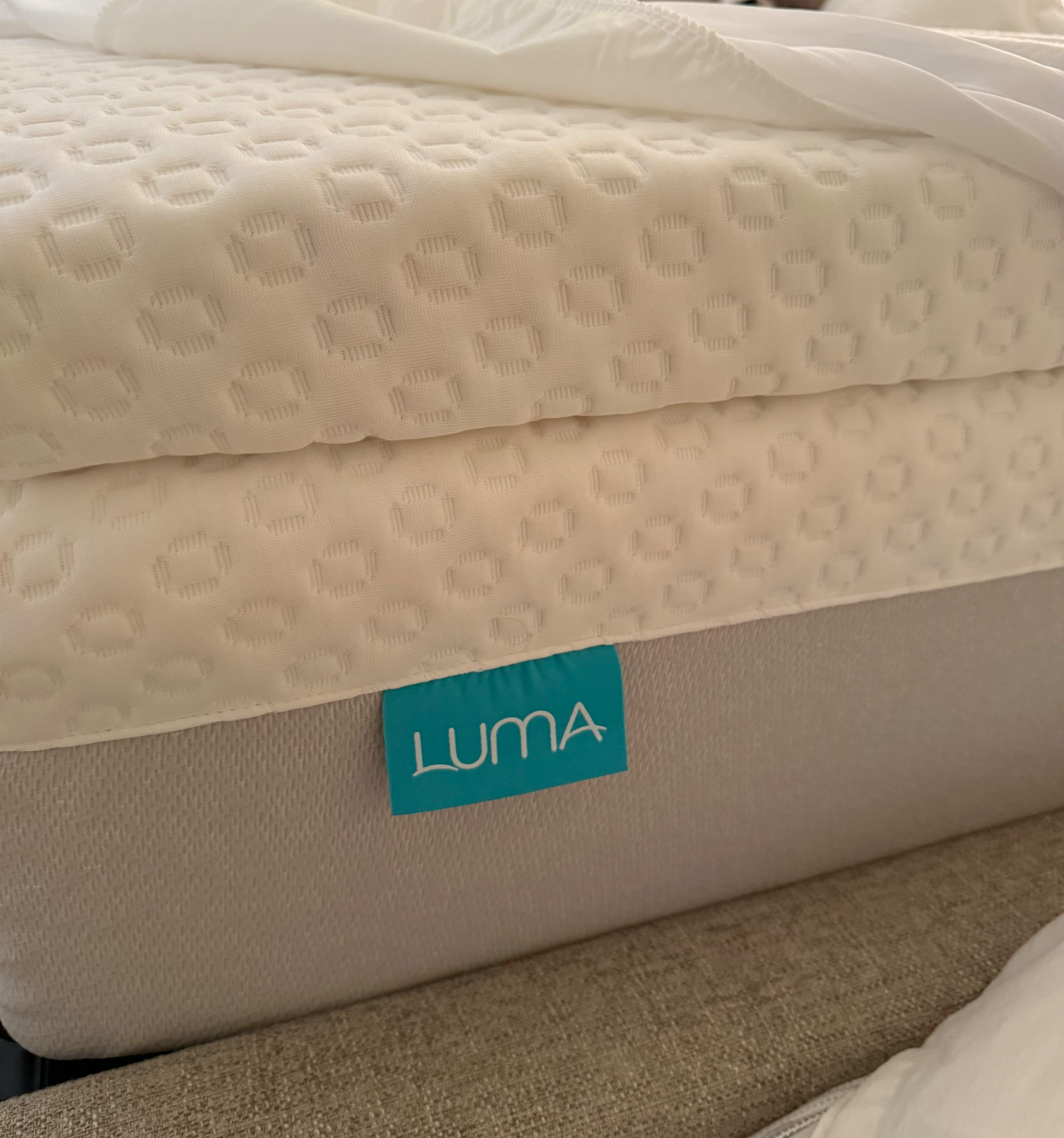
The details on my current Luna Sleep mattress’s construction are correct - the 3” talalay layer is truly a topper and separate from the rest of the mattress, and it’s in a very stretchy cover as @DLX thought. There seems to be some padding on top of the coils in the actual mattress itself, but I don’t believe that’s additional latex. Photo below:

The mix and match approach of a new mattress with a new topper definitely gives us something to think about. For some reason the thought never occurred to me, but that’s great advice. Thank you!

Thanks for posting the photo that confirms what we were thinking. Your Luma really was designed as two separate pieces: a support mattress underneath and a very stretchy-encased 3" Talalay topper on top. That construction allows the topper to move and conform more independently than an integrated latex hybrid.

If you were purchasing from us, we’d probably steer you toward our 10" Essential Two Sided paired with a 3" Talalay latex topper from a third-party supplier instead of our LatexLux. This will likely feel closer to what you’ve been sleeping on with the Luma.

The advantage of a separate topper is that it can contour more independently from the support mattress underneath, which is very similar to how your current mattress is constructed. It also gives you the flexibility to replace or fine-tune the topper years down the road without replacing the entire mattress.

1 Like