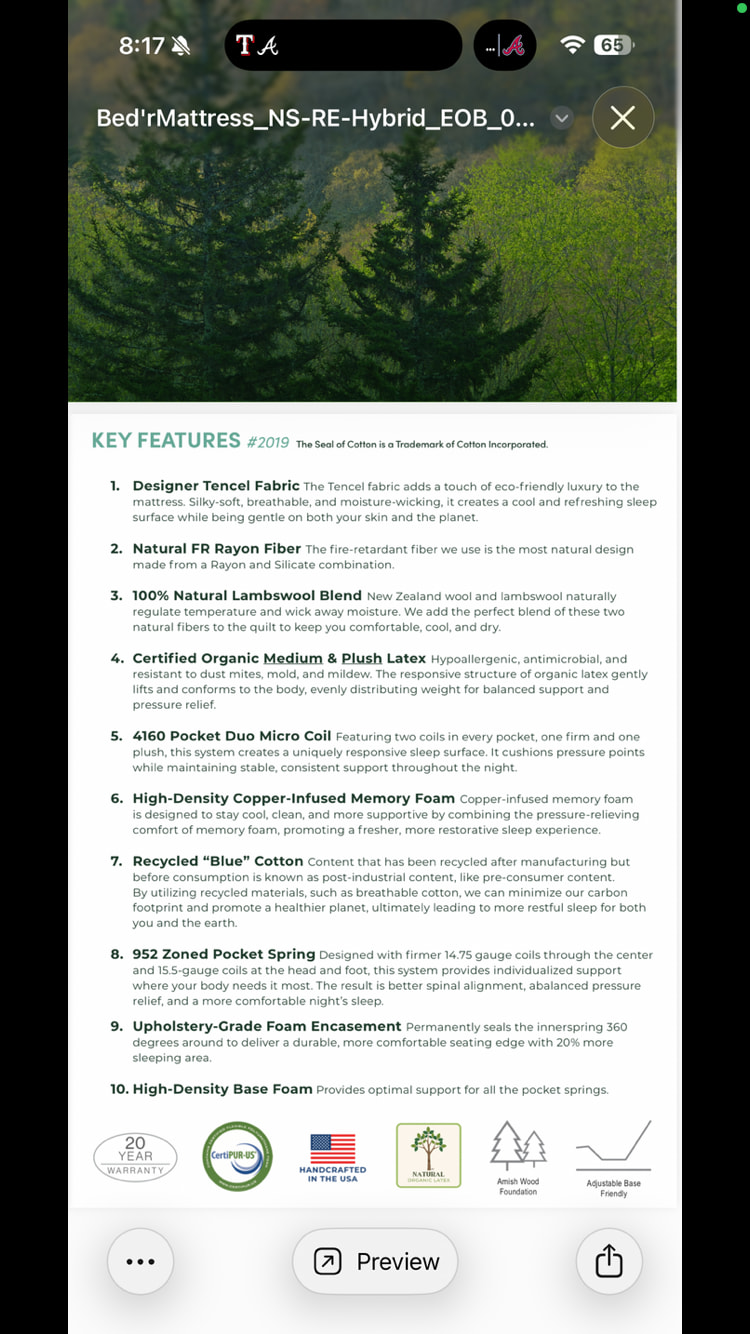
In looking at this Paramount Sleep Whispering Pine Mattress. Two things pop into mind as potential weak links. The High Density Copper Infused Memory Foam and the Perimeter Foam Encased Support Foam. Paramount makes very nice mattresses
When it comes to full transparancy, you would have to call and ask if they would give you the actual specs. Based on what is currently published. They basically describe the Foam Edge Encasement as “upholstery grade” whatever that means. They suggest that the Copper Infused Memory Foam is High Density, but they dont publish it, although I would love to believe it is at least 4lb.
They do not publish the height or thickness of the foam encasement. I think this is important. For example Beautyrest on one of the number series mattresses uses a 8" x 4" wide foam encasement. That is 8" that your spring support area of the mattress gets reduced, making a king 68" rather than 76, dropping it to almost an Olympic Queen sized. If a queen initially, drops a 60" to 52, smaller than a full sized. So you want to be careful with that.
I am not a big fan of foam encasement, this video speaks about it.
Coil gauge is important, but The Whispering Pine’s coil system appears to be a strength rather than a weakness. The 14.75 gauge center-zone support coils indicate a reasonably robust design, but coil gauge alone should not be used as a definitive indication for mattress longevity. The more important unknowns remain the foam densities, layer thicknesses, and the quality of the edge support system.
All in all, it looks like a fairly nice mattress. Is this one you are considering?
Maverick
Thank you for your response!
We are considering this one. I just don’t know if I can bring myself to pay that much! Toggling with trying a modified back science first whenever I can talk with them.
Hey there OfTheC,
I completely understand. Once you get into this price range, it’s worth slowing down and making sure you know exactly what you’re paying for. On paper, the Whispering Pine looks like a fairly nice mattress, and I don’t see any obvious red flags with the coil system. The bigger unknowns are still the foam components. “High Density” and “upholstery grade” are descriptive terms, but without the actual specifications they’re difficult to evaluate. Those details will tell you much more about the mattress’s long-term durability than the marketing language ever will.
Additionally, the Hypnos Cotton 8, while not a latex mattress, falls in the same price range and with a more traditional mattress feel also made by Paramount in the USA. The Williams and Company Oxford 2.0 is another mattress that falls into this price category but without the drama of wondering about the synthetic foam densities of the Whispering Pine.
Before making a decision, I would give Paramount a call or the Showroom you tested it, and see how transparent they’re willing to be. I would ask:
1. What is the density of the Copper Infused Memory Foam?
2. What are the thicknesses of each foam layer?
3. How wide and tall is the perimeter foam encasement?
4. What density and type of foam is used in the encasement?
5. Are there any additional construction specifications that aren’t published on the website?
I would ask Back Science the same questions so you’re comparing both mattresses on actual construction rather than marketing descriptions. Once you have those answers, you’ll be in a much better position to decide whether the Whispering Pine justifies its price or if the modified Back Science offers the better overall value.
BackScience does offer some nice customization options along the way, so that is a consideration too.
— Maverick
Maverick, I truly appreciate your feedback. The showroom that has that mattress is very transparent so I have no doubt I could find out all of that information and they could possibly even make a change if I needed them too.
The problem I am running into is just simply the price. I don’t think the back science is comparable on the type of materials, but the price would be less than half the price and I’m just wondering if I would be perfectly fine with that mattress so part of me thinks I should give that one a shot first. But I also don’t want to keep returning mattresses and tormenting my husband. Also, I tried to contact back science and have not heard back from them yet.
I think I’m to the stage where I just need to sleep on them to know because laying on them in the showroom is not going to tell me what a week sleeping on them would. And when I commit that much money to them to have them, tell me that if it’s not right, they would make me a topper. It doesn’t sound like a good idea. Back science is less than half the price and if I ever hear back from them, I might consider just trying them first to see if that one would be OK because I can always drop a fortune on the other one if back science doesn’t work and return the back science for $200
I also feel bad for taking up so much of the showroom guys time and then not even purchasing his product. But that’s not enough reason to pay nearly $3000 more. having a better night sleep is though.
I think you’re looking in the right direction. Back Science is definitely worth having in the conversation. One of their biggest strengths is that they are not just selling a mattress off the shelf. They are tailoring the build around the individual sleeper. Their customization options, along with their strong reputation for getting people into a mattress that works for their body type and sleeping position, are a big advantage.
The Whispering Pine is an attractive mattress and Paramount has a good reputation, but when you get into this price range, the ability to fine-tune the comfort and support layers can be worth a lot. Back Science’s approach is more about matching the construction to the person rather than trying to make one design work for everyone. This also means you can modify down the road too.
I would still ask both companies the important construction questions, because transparency matters. It seems from your experience with them, that wont be an issue. I am quite certain Back Science can give you the right feel and support combination while also providing options to customize from the building stages and in the home after, and it may end up being the better value. The best mattress is ultimately the one that fits your body and sleeping style, not necessarily the one with the longest list of features. Rick @BackScience is a great resource, since he created the mattress.
Best of luck and hopefully Rick will reach out and discuss any of the questions you might have.
Maverick
One thing I would pay attention to here is how much flexibility you have after the purchase. A lot of people focus heavily on the initial feel in the showroom, but the bigger question is whether the mattress can still be adapted if your body reacts differently after sleeping on it for a few weeks.
The difference between two expensive mattresses is not always just the materials. Sometimes it comes down to whether the company understands how to adjust the build around the person instead of expecting everyone to fit the same design.
What type of sleeper are you both (side, back, stomach), and are there any specific issues you’re trying to solve like pressure points, back discomfort, or needing different firmness levels?
He said “The foam encasement is 8 inches it encases the entire coil unit. 2 inches thick, 1.8 foam.
Copper memory foam density if I remember right they were using 4lb. It’s possible it is 3.5 lbs but I’m almost certain they were using 4lb. I know it’s no less than 3.5.”
now I have no idea what to do with those numbers so I’d love your feedback.
Thanks for getting those details.
Honestly, those numbers are pretty reasonable. I actually like the idea of the 2" foam encasement more as a way of stabilizing and containing the coil unit than thinking of it strictly as an edge support feature. It helps keep the perimeter of the spring unit consistent and well-behaved while still providing a stable edge.
As for the copper memory foam, if it’s 4 lb density, that’s a solid quality material. Even if it turns out to be 3.5 lb, I wouldn’t lose any sleep over it. While higher-density memory foams (like 5 lb) can have some durability advantages, formulation plays a huge role, so density by itself doesn’t tell the whole story.
At this point, as I previously mentioned, I’d be careful not to get caught up in analysis paralysis over every specification. Dr. Rick has already explained how much flexibility there is both in the initial build and afterward if any fine-tuning is needed. Nothing you’ve shared raises any red flags for me. I’d be more focused on the overall design and how it fits your comfort, support, and alignment needs than whether one component is 3.5 lb versus 4 lb.
Maverick