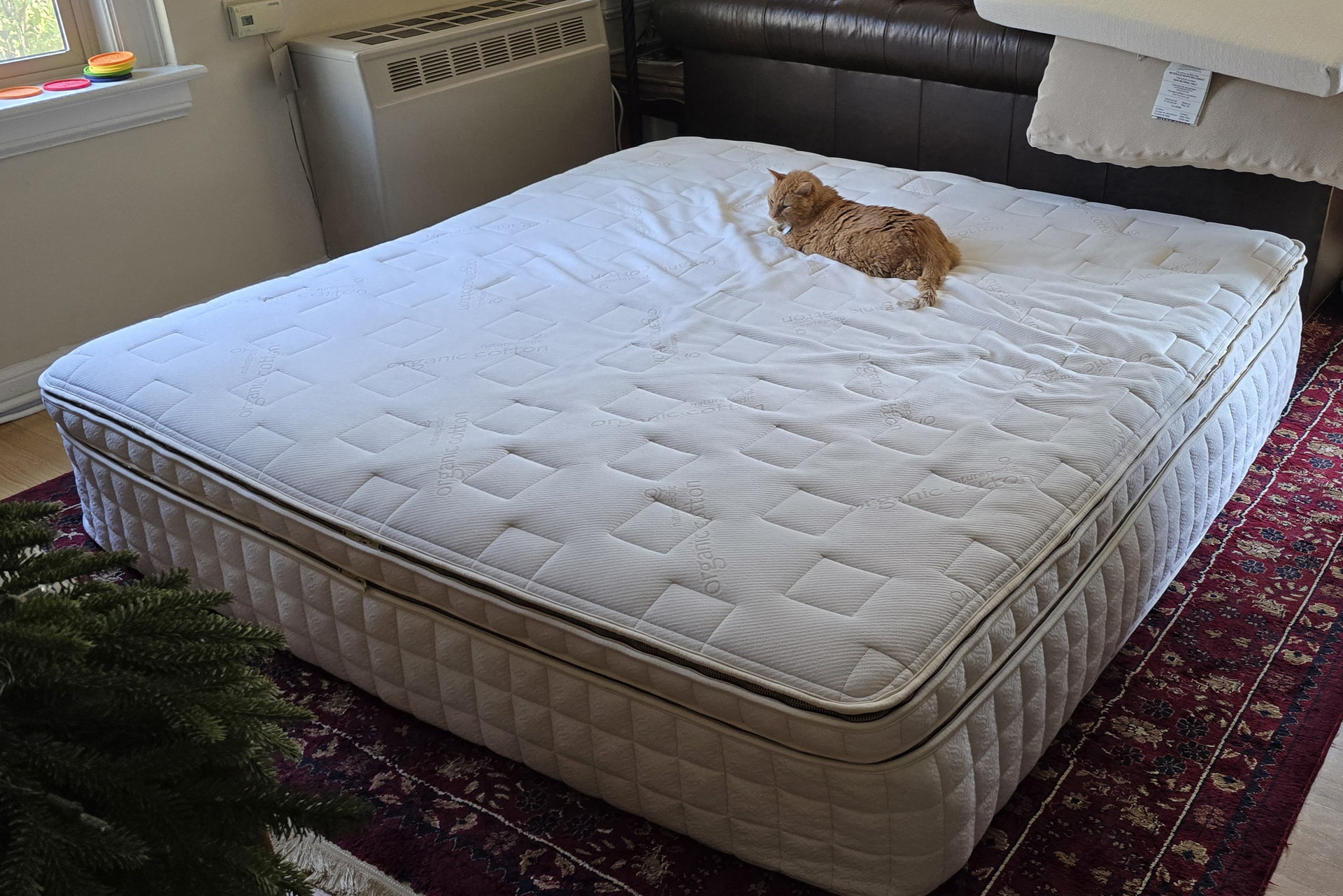
DIY version of the Naturepedic EOS Pillowtop

Looking to build a DIY version of the Naturepedic EOS Pillowtop since I sadly cannot afford a real one. I am a 5’7", 270lb, side sleeper. I like a soft bed.

I don’t know where to get a similar king size structured encasement with the very nice zippers and the pillow top like the EOS Pillowtop has. Does anyone know of a similar one on the market or a shop that makes custom ones?

The mattress stack I had in mind for the build, top to bottom:

3" Soft 100% natural Dunlop or Talalay latex. Not sure what the difference would be. Talalay is softer? In store I was told that all Talalay is a mix and not pure latex and will fail sooner than dunlop (she only sold dunlop) but I think the sales person who told me that might be mistaken.

3" Medium 100% natural Dunlop latex

8" 15.5 gauge quadcoils from Texas Pocket Spring

Latex layers I was going to purchase from either @Arizona_Premium or @Sleep_EZ. I haven’t been able to decide on one yet, both seem like very high quality products and excellent stores.

1 Like

That’s a good build. This is what I would do to achieve a similar feel to that EOS pillow top since you like a soft bed.

Thick wool topper (maybe one like this Amazon.com: Luxury 100% Organic Wool Mattress Topper Queen Size(Beige,(60"x80")) | 100% Australian Merino,Extra Soft Wool Mattress Pad for Back Pain Relief,Not prone to pilling and deformation : Home & Kitchen) they have king size as well on discount. I used this once on my DIY build.

Bamboo/wool encasement from mattresses.net
2" super soft blended latex
2"soft blended latex
2" medium blended latex
8" coils
I do think you need something for under the coils, though it might not be completely necessary. Either 1" of firm foam or latex. You do need to make sure the cover you get is holding in those coils securely.
At your weight the 15.5g is more prone to spreading out. I actually have the quadmini on top of the 14.75g and the springs are in their own encasement in order to hold them together. If your build height is going to be 14", just make sure the cover you get will also be that.

That’s just my idea, or you could use your build idea and emulate the pillow top feel with the wool pad. That’s what I did once on my DIY bed. Also, you don’t really HAVE to use a full 6 inches of latex on the top. You could do wool topper, 3" soft, then 2" medium then coils and save some funds.

Hi JayInSeattle and thanks for reaching out on this! I just want to throw a couple of things out regarding Talalay - our Talalay has the exact same ingredients as our organic Dunlop. All of our latex is made using 100% natural rubber from an actual rubber tree. The end product finishes at 98% pure rubber, and the remaining 2% of ingredients are things like natural fatty acids, natural soaps, and natural reinforcing agents needed for manufacturing.

Also, There is a noticeable difference between Talalay and Dunlop, and it’s not really that Talalay is softer than Dunlop. Most people and companies say Talalay is softer just because that’s an easier way to explain it. You can actually have a soft Dunlop layer that’s softer or firmer than a soft Talalay and a medium Talalay that’s softer or firmer than a medium Dunlop, etc. The real difference comes down to how they react when being compressed. Talalay is bouncier and springier and is generally better at contour and pressure relief on your hips and shoulders. Dunlop is denser and is generally better at support and maintaining proper spinal alignment so our most common configuration is Talalay for the top layer and Dunlop for the bottom 2 layers. We will recommend Talalay for two or more layers for customers that have things like fibromyalgia, chronic hip pain, chronic shoulder pain, or anything where they’re sensitive to pressure, or for customers that just prefer a bouncier / springier feel. Outside of those circumstances, a combination of Talalay and Dunlop offers the best chance to be successful for the average person. Again, the best way I can summarize the differences would be to say that Talalay is better at pressure relief on your hips and shoulders and Dunlop is better at maintaining proper spinal alignment and avoiding back pain. However, Talalay can also be helpful in avoiding back pain because it provides more of what we call secondary support. Secondary support fills in the gaps between your body and the mattress. For side sleepers, this is normally the area between a person’s ribs and waist. For back sleepers, this is normally the area between the small of your back and the mattress. If these parts or your body aren’t being held up by the mattress, your muscles will work all night to hold those parts of your body up, which can lead to back pain. Aside from that, women tend to be curvier, especially around their hips, and having a top layer of Talalay can help avoid hip pain and keep the mattress from pushing their hips up, which can also lead to back pain. As such, most of our customers definitely benefit from having one layer of Talalay on top, and Dunlop for the rest of the mattress, but it’s completely up to you what you would like to order.

With all that said, I think you’d probably do best with Talalay for your pressure relief and secondary back support, and use Dunlop and coils for your primary support. Actually, in your setup, the medium Dunlop layer will be more like a transition layer, where giving you some pressure relief and secondary back support but also some primart back support.