One Bed, Two Sleepers: The Honest Engineering of Split and Dual-Firmness Mattresses
About half the couples who walk into our showroom start the visit the same way: one of them apologizes for the other. “He likes sleeping on a board.” “She wants to disappear into it.” Then they both look at us like we’re supposed to referee.
We’ve been building layered latex mattresses since 2007, and shared beds are where the interesting engineering lives. One sleeper is a fitting problem. Two sleepers is a negotiation, and most mattresses settle that negotiation badly.
So, this is about the three honest ways to build one mattress for two different bodies, what each one costs you, and how to tell which camp you’re in, including the real possibility that you don’t need any of it.
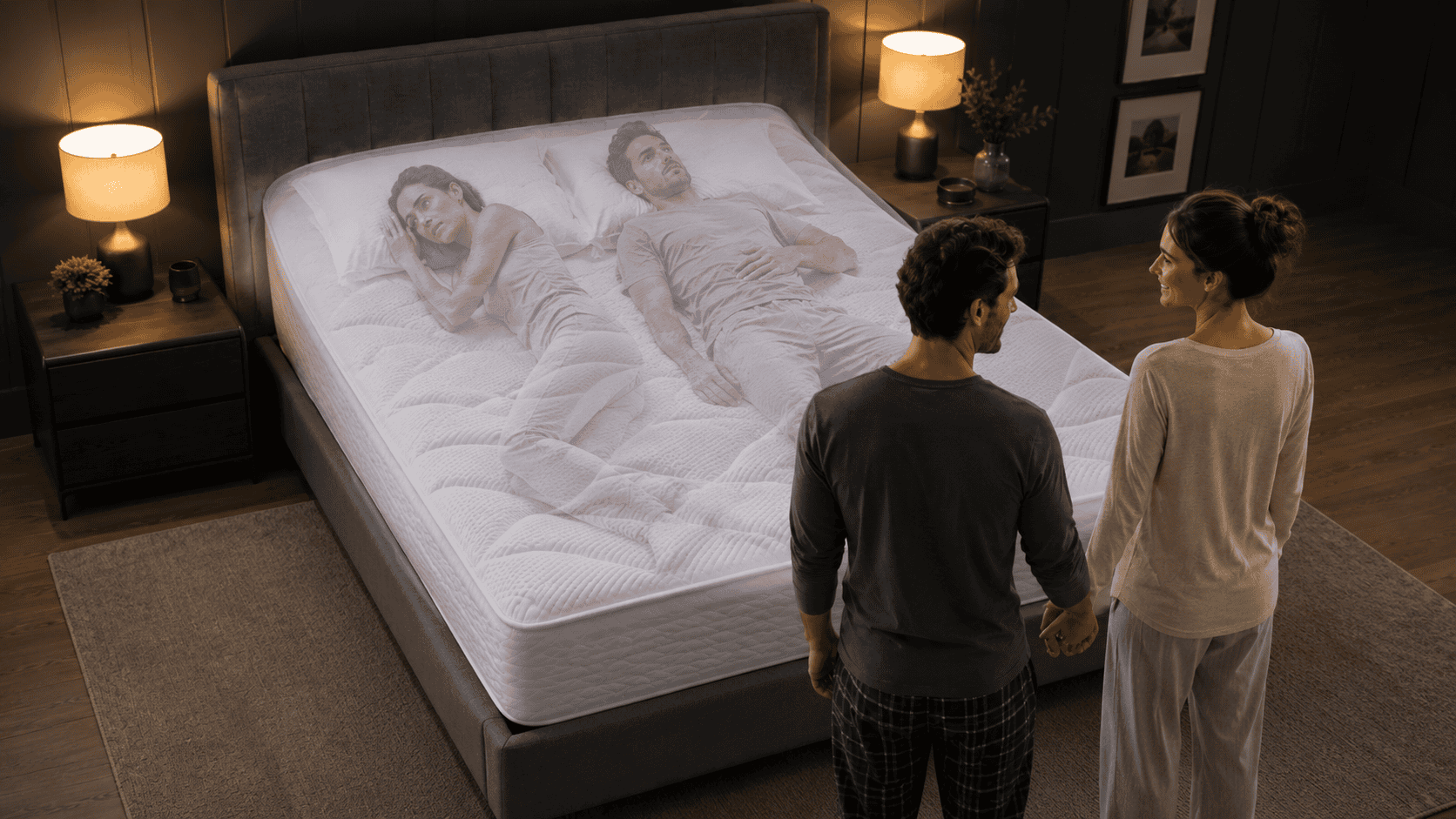 Couple with different needs and preferences, assessing a king mattress with a transparent overlay showing the same couple uncomfortable in different sleeping positions.[/caption]
 “Medium” isn’t a compromise. It’s a decision about who loses …
Picture a common pairing: a 135-pound side sleeper and a 210-pound back sleeper. That gap isn’t unusual. Looking back through two decades of orders, a 40-plus-pound difference between partners is closer to the rule than the exception.
 Q: What do most shoppers do? ➜ A: They buy one medium mattress…
This is what actually happens: The heavier sleeper compresses it deeply. His hips sink past the point the design intended, and the layers that were supposed to catch him are already spent. The lighter sleeper barely engages the same bed. To her, it reads firm, because her shoulder never sinks far enough to get any pressure relief out of the comfort layer.
Here’s the part the averaging math misses: firmness need doesn’t scale linearly with weight, so the midpoint between two right answers is NOT a right answer. It can be wrong for both people at once, in opposite directions. And the two of them pay on different schedules.
- The lighter sleeper pays night one, in the shoulder.
- The heavier sleeper pays on a delay, in gradual impressions and a lower back that files its complaint around year two or three.
The most expensive words in mattress shopping might be … “I’ll adjust.”
In our experience, the person who volunteers that is usually the lighter partner, and they’re usually wrong about it.
The three ways to engineer around it
There are only three real solutions, and every dual-firmness product we’ve ever seen is one of them wearing different clothes.
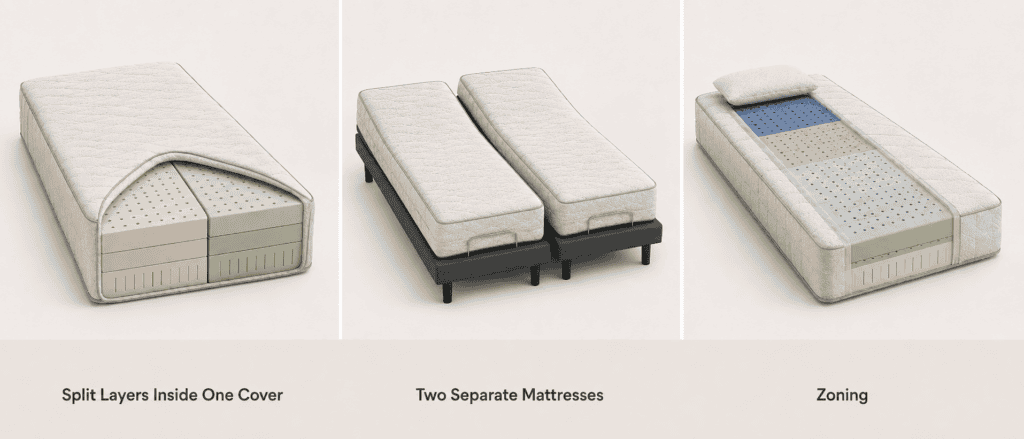
- One cover, split layers inside - A king or queen cover, and inside it each layer comes as two side-by-side halves, one firmness per person. The mattress looks like one bed, takes normal sheets, and mostly feels like one mattress.
The detail that gets glossed over: whether the top layer is also split changes the whole character of the middle.- Run a shared comfort layer across both halves and the surface is seamless, but that shared layer acts like a filter. Each side’s firmness reads through it partially averaged, and the lighter the sleeper, the more of their night is spent in that shared layer rather than in the split cores below.
- Split every layer top to bottom, and each side is purely itself. The “seam” is just two latex faces pressed together under a snug cover, and because latex is dense and floppy, they butt tight. There’s no gap to fall into. But press a hand at dead center, and you’ll feel the changeover.
- Two separate mattresses - The true split king: two 38 by 80 mattresses sitting side by side on one frame. Total independence. Firmness, height, even the entire construction can differ side to side.
This is also the only configuration that works with independently articulating adjustable bases. One mattress cannot hinge two directions at once, no matter what a salesperson implies. If you each want your own head and foot positions, you need two mattresses. Full stop.
The cost is a real seam between two covered edges, sheets that need solving (split-top sheets exist for a reason), and two beds that can wander apart over time without a strap or a snug frame. - Zoning - Firmer material under the hips, softer under the shoulders, built into one mattress or one side of one. Worth understanding precisely, because it gets sold as a couples solution and it isn’t one.
Zoning is per-region. Splitting is per-person.
Zoning solves the problem of one body needing different support at different points along its length. It cannot hand your partner a different bed. Where zoning earns its keep for couples is layered on top of a split: zone each half for its own occupant. On its own, it’s answering a different question than the one a mismatched couple is asking.
About that seam, honestly
The question every couple asks, and the one forum threads circle for years:
Will we feel the seam? ➜ A: The answer depends entirely on which split you chose.
A single-cover split stays sleepable at the center.
Two latex halves under a tensioned cover behave like one slab until the firmness difference gets large. Somewhere past ten ILD points of difference, a person straddling the middle notices it, mostly as a gentle lean toward the softer side rather than any ridge.
A two-mattress split has a genuine valley, and here’s the counterintuitive part: edge construction decides how bad it is. Mattresses with firm foam edge rails meet at the middle as two hard rims with a groove between them. All-latex beds with no edge reinforcement nest into each other far more forgivingly. “Better edge support,” the feature people pay extra for, makes the middle of a split king worse. We’ve seen customers figure this out the expensive way.
The bridging options, with their fine print:
● A seam wedge: A T-shaped foam channel that sits in and over the gap. Cheap, effective at killing the groove, does nothing about the firmness step.
● Strapping or a shared frame. Keeps the halves from migrating, which is half the battle. A gap that stays closed is a much smaller problem than one that opens by 2 a.m.
● One topper spanning both sides. A popular fix, and the one with a real tradeoff hiding in it: a shared topper partially averages the two firmnesses you just paid money to separate. A couple inches of soft latex over a firm side and a soft side makes both surfaces feel more alike. Sometimes that’s fine, because the difference you needed lives in the deep support, which still differs underneath. But the thicker the bridging topper, the more you’ve quietly rebuilt the compromise bed you were escaping. And on an articulating base, a topper spanning two independently moving halves gets shoved around nightly. Physics wins.
Our honest read: couples who want their bed to feel like one bed should split inside one cover and skip the bridging question entirely. The two-mattress route is for people who need what only it provides.
Motion transfer: what latex already does, and what a split adds
One of our favorite forum thread titles, because it’s the whole question in seven words:
Will split king solve motion transfer?
Honest answer: Yes, it will help; however, a latex mattress is not the best choice if motion transfer is your number one concern.
Movement crosses a mattress by traveling through a connected structure. An old-style innerspring, with its coils wired together into one lattice, is practically designed to carry a wave from one side to the other.
Pocket coils cut out the interconnected wiring and most of the transfer with it.
Latex has no lattice at all, and natural rubber is a high-damping material, especially Dunlop. It’s also point-elastic, compressing where it’s loaded rather than pulling its neighbors down with it. In all honesty,
Memory foam is better than latex at motion transfer.
Each material has its other pros and cons.
Motion Transfer Approach:
If you’re fleeing a bouncy connected-coil bed, then the change of material solves most of the problem before any split enters the picture.
So, a one-piece all-latex king removes some of the motion, but splitting it adds structural decoupling.
With a gap down the middle, the only remaining paths for vibration are the shared foundation and whatever you’ve laid across the seam.
If a partner’s turning wakes you, investigate the frame, which should be sturdy and solid.
Split for firmness independence or for articulation, and take the motion isolation as a free bonus.
If motion is still an issue, consider two physically separate mattresses, because a split mattress and bed frame are no longer suspects.
To sum up, if isolation is your number one goal with a latex mattress:
- Good: A latex mattress built with Dunlop latex in a medium firmness or greater.
- Better: Split latex layers under one mattress cover. Talalay latex will work, but again, Dunlop latex is the winner. In either a King or a Queen size.
- Best: Two separate twin XL mattresses butted up to each other, either with an adjustable base or not.
So, who should split?
Starting points from a couple of decades of these conversations, not laws:
- A weight gap of roughly 40 pounds or more is where per-side firmness starts earning its price. Below that, one well-chosen build usually serves both bodies, especially if positions match.
- Opposite positions raise the stakes. A side sleeper paired with a back sleeper is the hardest case we see: one needs the softest sensible surface, the other the firmest. That couple should split even at similar weights.
- Independent articulation decides it for you. Two head positions mean two mattresses. There’s no engineering around this one.
- Similar builds and shared preferences shouldn’t split. Within 25 or 30 pounds, same sleep position, both happy on the same showroom mattress: skip the split and put the money into getting one build exactly right. A split you didn’t need buys you a seam and solves nothing.
- Middle-of-the-bed sleepers should think twice. If you end most nights entangled at the center line, a two-mattress split will annoy you nightly. Split inside one cover, or don’t split.
Two people, two chances to guess wrong
We’ve said before that firmness is a fit problem, not a spec problem, and that first guesses are sometimes wrong. Couples double the guessing. Two bodies, two histories, two first guesses, and no requirement that they miss in the same direction.
That’s the quiet argument for split, layered, exchangeable construction, and it’s stronger than the seam debates suggest. When a shared one-piece mattress is wrong for one of you, the whole mattress is wrong. When one side of a split layered bed is wrong, you fix half a bed by swapping one layer, and your partner’s side never knows anything happened.
So, the question worth asking any manufacturer isn’t “should we get the split?” It’s “when one of us turns out to be wrong, what does fix half the bed cost?”
The makers with a good answer to that question tend to be the ones worth buying either kind of mattress from.
Brandon Maxey, Sleeping Organic
Written for The Mattress Underground Expert Forum. Original content; not published elsewhere.
All images and graphics in this article were created by The Mattress Underground.
Sleeping Organic website | Sleeping Organic ~ Trusted Member Profile
