So I have a full sized Naturepedic EOS with 8” firm base coils and 3”mini coils and it has started sagging recently and it’s not covered under warranty. I’m 5’3” about 160 lbs and the bed sinks so much when I lay on it that I had to roll up a cotton blanket and use it as lumbar support until I can fix this, I bought this mattress in February this year 2026. I saw that TPS has quad mini coils that are also 3” but says it’s 6” compressed into 3” casing, so hopefully these will be firmer and last longer? I love latex but it sleeps to hot for me so I prefer coils. Any advice would be great. Also what difference does “zoning” mean for coils?
1 Like
That should be covered under the warranty so I’m surprised they will not fix it. Our Ultimate Hybrid 8" CombiZone coil system uses small diameter coils and many of them in the center for more lumbar support and help prevents that dipping you are experiencing. On the heat issue I can tell you that Talalay latex, which is our specialty, has the best air flow of any foam out there and living in Phoenix air flow if a big deal. I believe Naturepedic uses dunlop which does have decent air flow but not a good as our Talalay. I caution against using anything on top that says it’s “waterproof” as that will greatly affect the air flow.
3 Likes
Check your foundation? 3" slats less than 3" apart, with a center bar? If not, time to invest in a good foundation. Bad foundations destroy mattresses.
1 Like
I have a KD Frames bed, the Lexington. It’s new, solid wood and I think the slat spacing is less than 3 inches. Good suggestion though.
The person I spoke with said they don’t warranty for “comfort”, only if there is massive obvious sagging. I told her it’s not a comfort issue and it is sagging. To me a comfort issue would look something like buying a firm mattress but you’re a side sleeper: the mattress functions as advertised but you need a plush mattress. The micro coils are medium and were nice and firm but supportive at first but now when I lay on it my back throbs from what feels like sleeping in a hammock on your stomach, though maybe not quite as dramatic. I can’t even sleep on my side comfortably, it just sinks. She said I could take pics and measurements of the sinking and try to file a warranty claim but she recommends using the latex instead of the coils, and a warranty claim would likely result in only replacing with more micro coils, and that’s IF they approve the claim, and she kept insisting it’s a comfort issue so it sounds like “no”. Also, their warranty changed this year, you have to ship the faulty mattress or parts back to them in order to get a replacement, which sounds damn near impossible for many and especially for me because I’m disabled, so basically good luck trying to actually use the warranty, that feels really scammy. Naturepedic doesn’t have anything firmer than medium in regard to micro coils, and the latex is too hot for me to sleep on. So I’m screwed. She said she isn’t supposed to give me a discount but offered 20% off of extra firm base coils to see if that would help, but with the discount that makes them $800, I’m already close to $3,200 deep into this mattress. TPS has similar parts for half the price so at some point I may order from them instead.
Edited to add that I have to use a rolled up cotton blanket and drape it across the mattress is for lumbar support so my middle doesn’t sink too badly.
1 Like
Hey there sleepless,
I was reading through the thread and wanted to share some thoughts. I agree with APM regarding dunlop vs talalay and that a sagging problem should be a warranty issue, with a caveat.
The Lexington is actually a pretty nice frame, and the 2.8" slat spacing should be fine. However, there’s one thing I’d want to check. The Lexington is designed to have a trundle slide underneath the main bed frame, which means there may not be any center supports running head to foot to support the slats and everything above it, assuming they do not offer center supports when a trundle is not ordered.
I’d get underneath the bed and, if possible, have someone take a video of the underside while you’re getting onto the mattress and moving around. Look for any bending or flex in the slats, even if it’s slight. If the slats are flexing under your weight, everything above them will follow, and that could be contributing to the sinking you’re experiencing. Do not make the assumption that because the KD frame is a nice quality frame, that it couldnt possibly be contributing to the issues.
I’m not saying that’s definitely the problem, as your version of the frame may have center supports, but I’d want you to rule it out before spending more money on different coils.
If the foundation checks out and the mattress itself is losing support after only a few months, then I agree it deserves a proper warranty evaluation. There’s a difference between a comfort issue and a mattress that has actually lost support.
Naturepedic makes a nice mattress, but even good manufacturers can have a defective product. It’s also not uncommon for someone to experience enough hammocking to make a mattress uncomfortable without that necessarily meaning the mattress is defective. It may simply be that the construction or design isn’t right for their needs. There is a genuine distinction there, and it’s worth understanding both sides of it.
The problem is that most quality manufacturers are going to push back if they don’t believe the mattress meets their criteria for a warranty claim. That doesn’t necessarily mean they’re right about what’s happening to you, but their definition of what constitutes a warrantable sag and yours may be two different things.
Perhaps if you approach Naturepedic with the mindset of working together to find a solution, rather than getting caught up in a back-and-forth over whether this is a comfort issue or a defect, you might get further. I know that’s easier said than done when you’ve spent that kind of money and are struggling to sleep, but for now, I’d focus on getting them to help resolve the problem rather than trying to win the argument over terminology.
My approach would be to first inspect the slats from underneath the bed, ideally with someone taking a video while you’re on the mattress. I’d also take some pictures of yourself lying on your side, showing how deeply you’re sinking into it. Those won’t necessarily prove a defect, but they’ll help document what’s happening.
Then I’d go back to Naturepedic and ask a simple question: How do we solve this problem? Whatever the cause, the mattress isn’t working for you, and you need to find a way forward. For all we know, there could be an issue with the microcoils themselves, or the particular coils used may simply not be appropriate for your needs. We don’t know that yet, and that’s the point.
Your job now is to work with them to figure it out, as frustrating and gut-wrenching as that may feel. I’d exhaust that avenue before putting more money into replacement components.
Maverick
2 Likes
Ok. Do you sell any mattresses? Have any that you recommend for a stomach sleeper?
2 Likes
The Mattress Underground does not sell products. We may recommend, guide and advise, while our trusted members offer product solutions.
For stomach sleepers, aside from an extremely robust and supportive frame, equal emphasis must be placed on the support system of the mattress. If the underlying support is not there, stomach sleepers will struggle.
As for recommendations, I would actually like to circle back to your Naturepedic EOS before suggesting that you replace it. You’ve already invested a considerable amount in that mattress, and I think there may be a way to configure it that would better suit your needs.
First, I would want to rule out any problems with the foundation and establish whether the mattress itself has lost support. The Lexington is a nice frame, and I mentioned that the 2.8-inch slat spacing sounds reasonable, but I would still check for flex in the slats and confirm that the frame has adequate center support as I previously mentioned and described. If the foundation checks out, I would pursue a proper evaluation of the mattress components with Naturepedic. There is a difference between a mattress that doesn’t suit someone’s comfort preferences and one that has actually lost support, and your description warrants looking into that distinction before spending more money. As mentioned, leave the who is right and wrong at the door, you will not win that argument.
Regarding the EOS, I would ask Naturepedic about replacing your 3-inch microcoil comfort layer with a 3-inch extra-firm Talalay latex layer, potentially retaining your existing 8-inch firm support coils. I would first confirm which combinations are compatible with your particular EOS model.
The reason I suggest this is that extra-firm Talalay may provide a more resistant, resilient surface than the medium microcoils you currently have. For a stomach sleeper experiencing excessive sinkage beneath the pelvis, it is a configuration worth investigating. I realize you find latex too hot, so I wouldn’t promise that this will solve that issue. Talalay, as APM mentioned, has good airflow characteristics, but personal experience with sleeping temperature matters more than general claims.
I would also be cautious about spending another $800 on replacement base coils before determining what is happening with the current setup. If the microcoil layer is contributing to the problem, changing only the base coils may not resolve it. Likewise, if a component has actually failed, that needs to be addressed.
If the EOS cannot be made to work, there are three mattresses I would investigate.
The Back Science Series1 would be one of my first candidates to try. It is a firm hybrid with a targeted lumbar-support design, making it worth investigating for someone who wants a more supportive sleeping surface.
Back Science Series 1
The McRoskey Mission is worth considering if you prefer a traditional innerspring feel. Its spring construction and natural comfort materials may appeal to someone looking for a responsive alternative to a latex-heavy mattress. I would confirm the available firmness before making a recommendation.
The Vispring Elite is another possibility. It uses pocket springs with natural wool-and-cotton upholstery, and firm and extra-firm spring tensions are available. It offers a different approach to support without a latex comfort layer, although I would want you to test it in person to make sure the upholstery doesn’t allow more sinkage than you’re comfortable with.
I wouldn’t choose any of these based on firmness labels alone. The important thing is to lie in your normal stomach-sleeping position and see whether your pelvis remains supported without creating uncomfortable pressure elsewhere.
I think you should try to establish what is happening with your EOS first, then investigate whether the extra-firm Talalay configuration is a viable option. If that doesn’t work out, I would start comparing the alternatives above.
You’ve already invested a substantial amount in your current mattress, and I would hate to see you spend more money on replacement components or an entirely new mattress without first exhausting the reasonable options available to you.
The goal isn’t to find the hardest mattress possible. It’s to find a construction that supports your body in your preferred sleeping position without excessive sinkage or uncomfortable pressure.
Just some food for thought.
Maverick
2 Likes
Makes sense. I live alone so I don’t have anyone that can check the frame/bed while I lay on it. It does have to long slats the run up the middle of the bed, so maybe those are the center supports that you speak of? The other issue is that in order for them to replace anything I would have to ship the old coils back, and I don’t think I can do that. They are very heavy and I’m disabled and don’t own a car. I also don’t know if they would charge to ship, but it doesn’t matter at this point if I can’t get it back to them anyway. They only have dunlop latex, no talalay. If I want to stay with coils I think I would have to order some from another company. TPS has quad mini’s that are 6” coils compressed to 3”, which should fit in my mattress and are only about $300-400. There might be other places to get mini or micro coils but I need to know if they are firm and compressed, maybe compressed will last longer? I don’t want to resort to getting a new mattress right now, just listening to options in case I end up going that route. I just order a foam support on amazon that goes under the mattress to prevent sagging, it’s cheap and has decent reviews and is just a temporary fix until I figure out what to do. Do you know of other places beside TPS that have coil components? Or do I really just need talalay? I love latex but it sleeps so hot for me.
The center supports of the frame are legs attached to the slats that sit on the floor making sure the slats aren’t over flexing when you lay on the bed. The firm base springs of the eos are pretty strong so I don’t think that should be the issue. Though the mini coils are medium firmness and just buying another layer of those is likely to not fix the issue. Maybe a good solution could be to use a firm layer of latex on top of the base springs, and then the mini coil as the top layer under the quilted top.
You actually don’t need that much material to hide the feeling of the springs. Engineered sleep built the duo lift with just two inches of wool sewn into the top on top of the quadmini.
I see, no there are no center feet.
1 Like
Ahhh… That’s probably the issue and what Maverick was inferring. You can buy attachable supports on Amazon that will connect to the slats and go down to the floor to give your frame more hold up. They’re inexpensive. Making absolutely sure there is no flex happening with those slats is the most important thing.
What you could do is start recording on your phone with it zoomed close enough to see what the slats are specifically doing, then set it up against the wall pointing at under the bed. Then go and lay on the bed and see if they are flexing at all.
1 Like
The first step I would do after the foundation is examined is to ask Naturepedic to swap out the medium microcoils with a firm latex layer. Given your size and weight you are not going to boil with that firm latex comfort layer. Investing in a wool mattress protector should help dissipate any excess heat. If your firm base coils are not defective that combination should provide adequate support for a stomach sleeper.
1 Like
Oh yeah, duh  I didn’t even think about using the camera on my phone. If the center supports are cheap then I may just buy them anyway, couldn’t hurt to have extra support.
1 Like
Hello,
I would be happy to offer you some advice based on my 25 years of experience as both a mattress designer and a Doctor of Chiropractic.
Maverick from TMU provides excellent guidance, and his recommendation for the Back Science Series 1 is completely spot-on for this situation.
To answer your question about “zoning”—zoning in a coil system means that different sections of the mattress have varying firmness levels designed to support the different weights of your body parts. A common issue with standard, uniform coil systems or mini coils is that the heavier pelvic and hip region compresses the springs much faster and deeper than the lighter upper body. Having to use a rolled-up blanket for lumbar support is a classic structural indicator that a mattress lacks the targeted center support necessary to keep the spine neutrally aligned, leading to an uncomfortable hammock effect.
While dense, compressed mini coils can offer a different feel, without proper zoning, the fundamental issue of the hips sinking too deeply often remains. Here is how the Back Science Series 1 specifically resolves this:
1. True Lumbar Support: To permanently eliminate the need for a rolled-up blanket, the underlying structural support system utilizes our patent-pending Lumbar-Flex™ Zoned Support. It actively reinforces the center third of the bed, giving the pelvis and lower back the rigid, elevated support they need without making the top of the bed feel like a rock.
2. Cool, Latex-Like Response: The buoyant, responsive feel of latex is incredibly popular, but its tendency to sleep hot is a very common drawback. The Series 1 provides that sought-after resilient support without the heat, utilizing our proprietary ventilated materials and a Kool-Flow™ micro-vented bamboo cover that breathes exceptionally well for a temperature-neutral sleep.
3. A Customizable Solutions: If you find you are still sinking too deeply or if the mattress feels too firm, you do not have to worry about having to settle on the wrong solution for your needs, since we offer free customizations at no cost whatsoever to ensure that the mattress properly suits your needs. This is easily accomplished thanks to our GripLock modular cover system, whereby we can exchange internal components that will change the level of firmness and support of the mattress right from your own home.
I would love to help you finally get a comfortable night’s sleep with the proper structural support. Also, by utilizing the code TMU10 for your Mattress Underground member discount, we can ensure you get a fantastic value.
You can explore our designs and see how our zoning works at www.BackScience.com or www.Ultrabed.com, and feel free to reach out to us directly at 800-667-1969 to me or my staff if you want to discuss any of this in more detail.
Thanks!
Rick
Dr. Rick Swartzburg, D.C.
Founder and Vice president of Product Development
1 Like
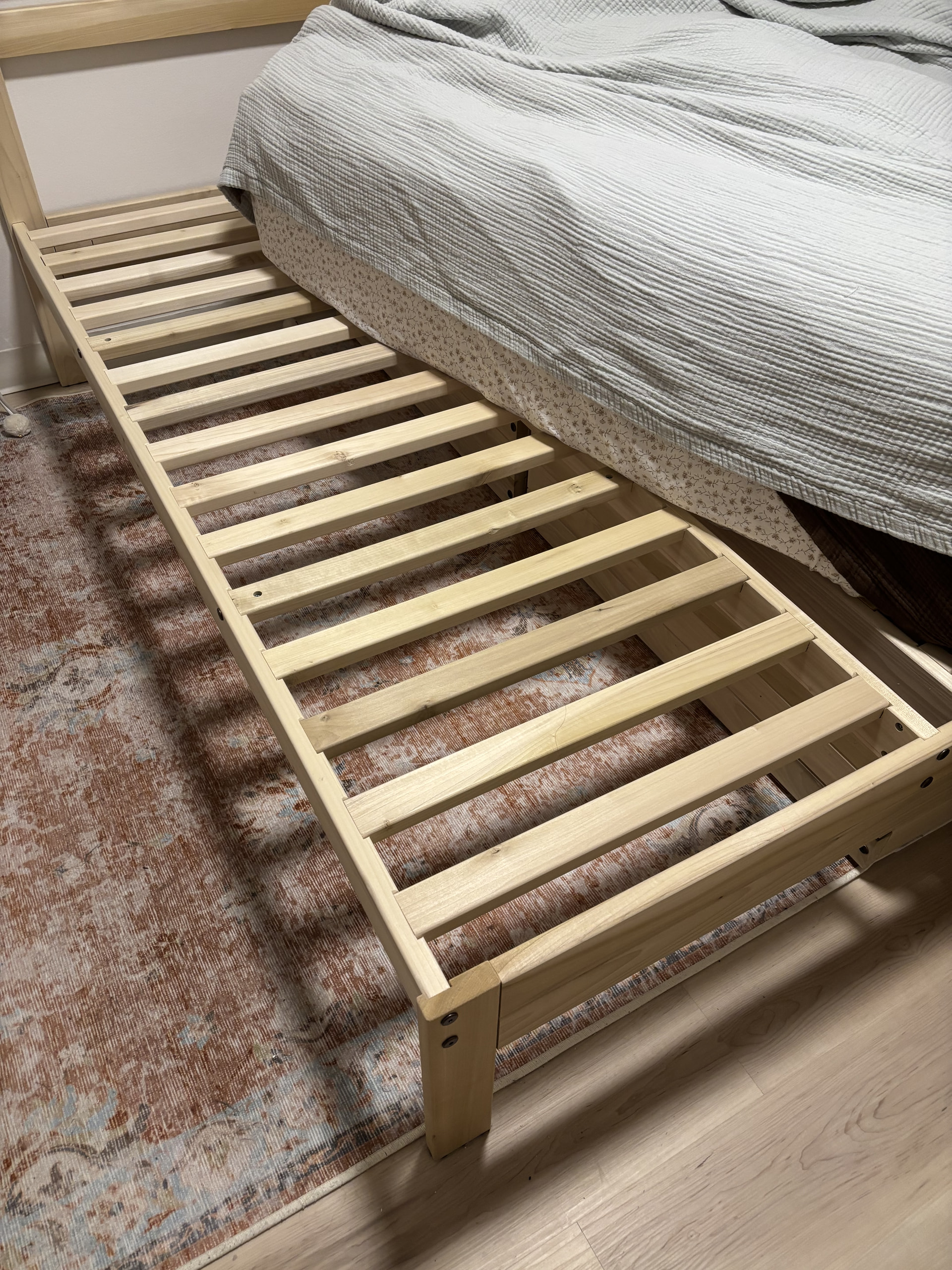
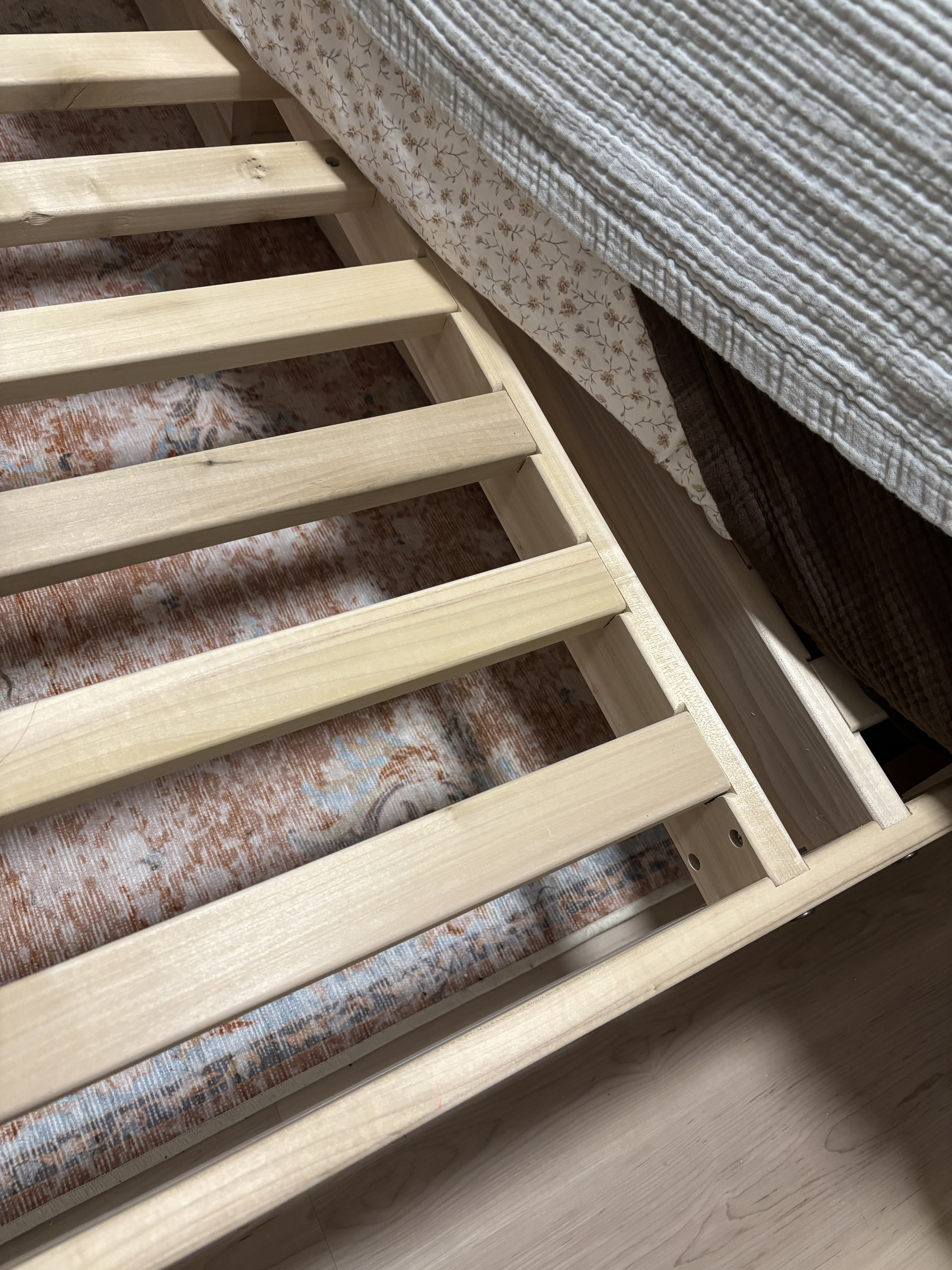
Hey so I got a video of the underside of the bed when I lay on it, and a couple of photos of what the slats look like. I have two large drawers under the bed but pulled them out when I took pics of the frame. This website won’t let me upload the video unfortunately. The wood slats do move down a little when I lay on the bed, I think? Also if I buy the support legs, should I put them on one of the smaller slats under where I sleep or on one of the two center support slats? Thanks!
2 Likes
I looked up your model at KD and the slat spacing. At 2.8", that spacing looks reasonable, so I’d focus next on the support beneath the bed. Since there are currently no support legs, you can add support legs in two areas. Visually, it looks like a very nice frame. By the way can you measure the thickness of the slats, just for my curiosity. The preferred thickness is 3/4" but that can vary depending on the hardness of the wood.
Look at adding support beneath the center rail first, at least 2 or 3 evenly spaced down the center Head to Foot, start in the center and one above and one below. Then consider a few additional legs spaced along the length of the bed beneath the slats in the main sleeping area. You dont need to do both sides as it will block the drawers from being used. The challenge is making sure the legs can provide proper support without interfering with the drawers. If the drawers prevent the legs from being positioned where they’re needed, you may need to leave some drawer space unused, at least temporarily until we can figure what that issue really is.
Additional support may help if the frame is contributing to the sagging, but we’d want to distinguish that from any sag originating within the mattress itself.
Also, have you rotated the mattress (if you mentioned it, I forgot)? If not, have you unzipped and rotated the internal layers. I know this is frustrating as can be, but the goal is to prevent this from happening either with this mattress, if and when modified, and any new one you attempt to replace it with.
Maverick
1 Like
All of the slats and center supports are 1” thick. The slats that are slept on are 2” wide, the two center support rails are 3” wide. I have rotated the micro coils twice since I bought it in February, Naturepedic didn’t recommend to do so but I thought it might be a good idea. The base coils are heavy as hell and sit at the bottom of the encasement so I haven’t been able to take that challenge on yet. I paid to have the company set it up for me. How often should the base coils be rotated? Maybe I should just try rotating the whole mattress… (this would make the zipper access a pain but it would be easier to rotate). Also, don’t know if this matters or helps, but the wood is made of Tulip Poplar, which is a softer wood.
1 Like
Hi again,
If the horizontal slats are 1" thick and the center support rails are also 1" thick, that sounds like a fairly substantial bed frame. However, even solid wood slats can flex under load, so I would still recommend adding center support legs, provided they can be positioned without interfering with the drawers.
Before investing in replacement components, here’s what I’d suggest: place the mattress directly on the floor and sleep on it for 3–4 nights without rotating it. Let’s see whether the sinking improves when we eliminate the bed frame as a variable.
If the mattress feels noticeably better on the floor, that would suggest the frame is contributing to the problem, and adding center support legs would be the logical next step.
If it continues to sink excessively on the floor, I’d then rotate it 180 degrees and compare how it feels over the next few nights. This may help us better understand whether the problem is consistent across the mattress or varies with the sleeping area.
My suspicion, if the frame isn’t the culprit, would be that the 3" mini-quad layer isn’t providing enough resistance to compression for your needs, despite the 8" firm base coils underneath it. If that’s what we’re dealing with, we can explore replacing the mini quads with a firmer layer. I know you prefer coils because latex sleeps too hot for you, so I’d want to weigh that preference carefully before recommending a change. Or we can eliminate the miniquad layer altogether and see how that feels.
Let’s establish where the problem is coming from first, so you don’t spend money replacing the wrong component.
Hopefully this makes sense.
Maverick