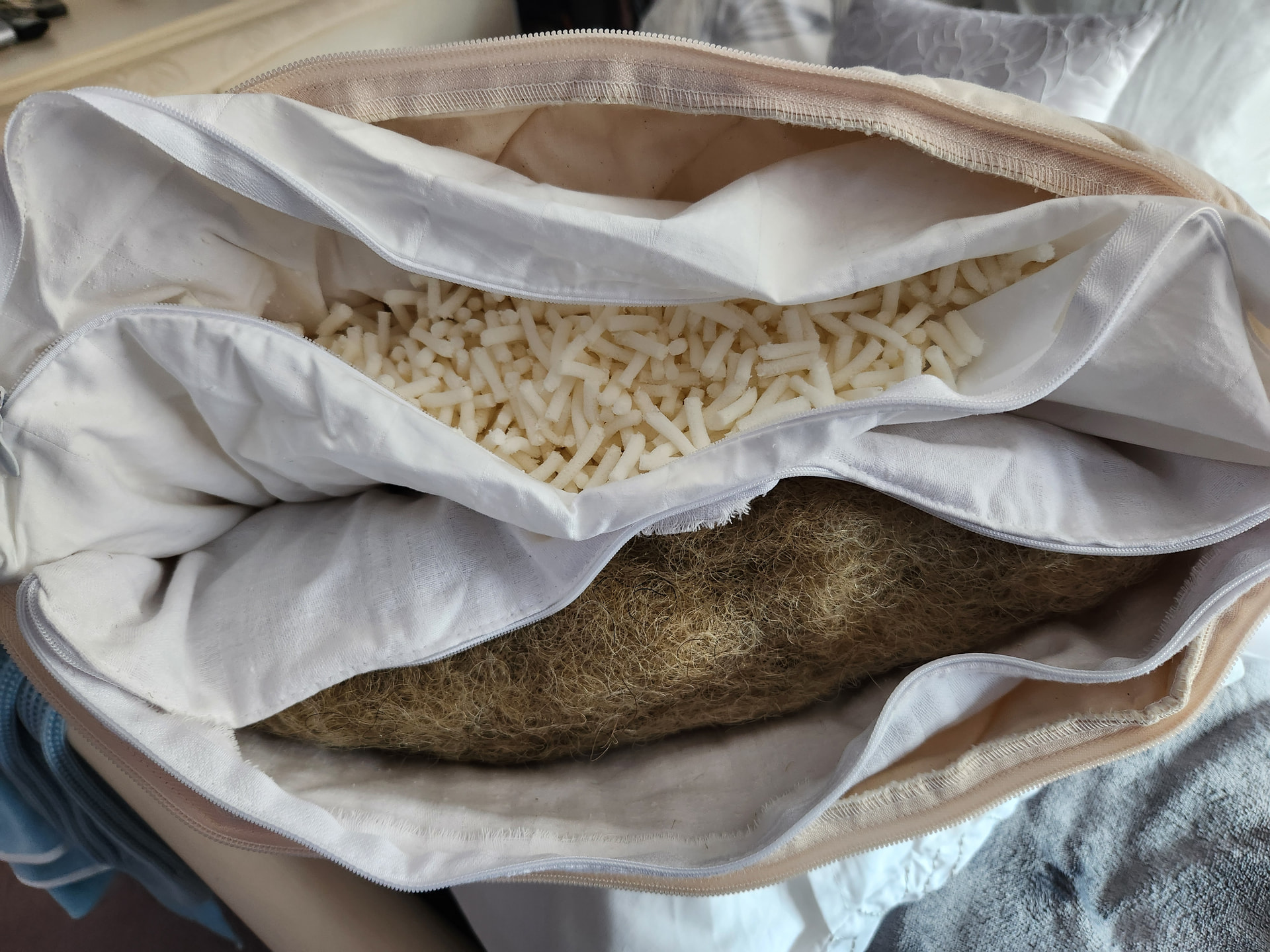
It sounds like you’ve put a tremendous amount of thoughtful experimentation into your builds, and I really appreciate how intentionally you’re approaching material behavior rather than just chasing loft numbers. I have tried a couple of “side sleeper” crescent shaped pillows, but they have never worked out for me. In that regard the Oxygen-Pillow is a better fit, as it has a firmer perimeter with a hollow center, which allows me to sleep on it whether on my side or back, and still get plenty of support. And it is very easy on the ear, which is something you seem to have issues with.
I haven’t personally tried wool bolus yet, in combination with latex noodles, but I’ve experimented quite a bit with different fiber and foam combinations, and I’ve noticed many of the same mechanical principles you’re describing. Here is a
of one of my favorite builds using latex noodles and horsehair. Horsehair, for me, is incredibly resilient and progressively firms up as it compresses, which I really enjoy from a support standpoint. At the same time, there are moments when I want more surface cradling, and the latex noodles seem to introduce just enough elasticity and contour to balance that out. In combination, I find it makes for an extremely comfortable and responsive pillow.
I’ve also experimented with wool batting from Sonoma Wool Company, and one of the more interesting discoveries was how the same fiber can either soften or firm up a structure depending on how it’s applied. For example, wrapping a thin layer of wool around horsehair takes the edge off the initial firmness and adds a bit of cushioning without sacrificing resilience. Conversely, wrapping wool around latex noodles can actually stabilize and slightly firm up the feel by limiting how freely the foam expands and shifts. It is quite interesting how the same fiber can both soften and firm up a build depending on placement and compression dynamics. That kind of vertical zoning can help maintain loft while reducing peak pressure, rather than simply adding more fill and increasing overall density.
I’ve even made the core of the pillow entirely wool, with the outer chamber filled with latex noodles, and I’ve also created two sided pillows. Instead of a traditional core surrounded by fiber or foam, I have constructed one side fiber dominant and the other side foam dominant. That way I can flip the pillow depending on what my body seems to prefer that night. I also strongly prefer using symmetrically cut pieces of latex, whether noodles or evenly and symmetrically cut cubes. There seems to be something about how symmetrical cuts interact under load. They cradle and support in a much more cohesive and predictable way than randomly cut pieces of foam. Random cuts and irregular shapes just do not perform the same way in my experience. When the pieces are cut evenly, they stay in place better and compress more smoothly, so you don’t get that splitting or shifting in the middle overnight, plus they are more predictable on how they will perform when you add or remove fill.
Somewhere along the way I also switched from the Iris Bio Sleep concept cover to the Bedrooms & More wool quilted cover. The Iris felt slightly thicker and a bit more structured, whereas the Bedrooms & More version is quilted with wool and just a touch thinner. Even though both sleep cool, I find the wool quilted cover sleeps a bit cooler and feels slightly less restrictive. That small difference in quilting material and thickness seems to reduce surface tension just enough to let the fill compress and rebound more naturally. The cover really does act like a shallow pre compression layer, and even subtle differences there can influence ear pressure and perceived density.
Another trick I’ve learned is to use a standard size pillow liner even when placing it inside a queen size quilted cover. Despite the slightly larger outer cover, the quilting occupies the extra space well, and the smaller insert effectively increases loft without requiring more fill. Instead of adding material and making the pillow denser, you are leveraging the geometry of the cover to achieve height more efficiently.
For ear pressure specifically, I have had success taking two inserts and forming them into log shaped rolls within the cover. Placing them side by side creates a subtle split or channel, so the ear is not bearing the full compressive load. That small relief zone can reduce pressure while maintaining overall loft and neck support.
One additional cover I like to use is the stretch cotton envelope style cover from European Sleep Works. I will place my insert inside that stretch cover first, and then put the entire assembly into the slightly larger quilted outer cover, standard insert inside a queen cover. The stretch layer allows the fill to articulate and offer some give before engaging the more structured quilted shell. This adds surface softness and cradle, helps with ear comfort, and still prevents bottoming out because the underlying structure remains supportive.
In my experience, small architectural adjustments such as cover stretch, quilting material, insert sizing, internal shaping, and symmetry of cut foam can influence comfort just as much as changing the fill itself. Often it is not about adding more material, but about refining how the system compresses, distributes load, and rebounds over the course of the night.