Trying to dial in a Sleep EZ layered mattress having a lot of lower back pain and stiffness

I am 5 ft 7 inches and weigh 115 lbs, curvy but heavier in the hips age 68. My current configuration is top down- 1 inch soft Talalay, 3 inch medium Dunlop, 1 inch gel memory foam, 3 inch firm Dunlop, 3 inch firm Dunlop with mattress cover removed and stretch cotton sheet. I always do the child’s pose morning and night to loosen up back and check for stiffness. I could not reach head to floor with this layering. Have had layer combo that I could reach the floor in the morning but still had some pain and stiffness, no pressure. My alignment angle was about 12 to 13 degrees this morning with my shoulder raised starting at upper back.

Any suggestions on whether to add to top soft layer, rearrange layers or try zoning to sink my shoulders? We have considered replacing support layers with coil springs.

My husband is 5 ft 10 inches, 225 lbs, age 69. My husband is sleeping OK on his layering, which is 3 Talalay soft, 3 inch medium Dunlop, 3 inch firm Dunlop, 3 inch extra firm Dunlop, although he has added a doubled thin rug underlayment under his hips and a single layer down his legs below the top soft layer.

Thanks for any insight you can offer.
@Sleep_EZ

Hello,

Thank you for such a detailed explanation of your experience and setup—I appreciate the level of detail you’ve provided.

Before I make any specific recommendations, I want to make sure I’m working from your exact, current configuration, because what you’ve described includes a couple of components that are not part of our standard SleepEZ modular system (specifically the 1” Talalay layer and the 1” gel memory foam layer). Those additions can significantly change how the mattress performs and make it very difficult to accurately assess alignment or pressure based on our normal system design.

To make sure I give you the most accurate guidance possible, can you please confirm your current mattress build in full order from top to bottom, including all layers that are inside the cover as well as anything being used outside of it?

Once I have that confirmed, I can give you very specific recommendations based on your body type, sleep position, and the way our 10” and 13” systems are intended to function. In many cases, when we see mixed thin layers or non-standard components added in, the best first step is simplifying back to a standard 3” or 4-layer configuration so we can properly evaluate support, alignment, and pressure relief before making targeted adjustments such as zoning or firmness changes.

From there, I can also help determine whether adjustments to shoulder sink, hip support, or even coil support would be beneficial for you and your husband’s differing needs.

I look forward to your confirmation so I can help you dial this in properly.

Warm regards,
Jeremy

1 Like

Hi Jeremy, thanks for the reply. You are correct 2 components I am using are not from Sleep EZ. I am sure sleeping on a worn out bed for over a year did not help my back. It was hurting in the morning on the worn out bed.
From top to bottom I have 1 inch talalay, 3 inch medium dunlop, 1 inch memory foam, 3 inch firm, 3 inch firm. No mattress cover.
Husband had shoulder and hip pressure so we took the cover off to see if it would help.

Our original setup was Husband: top to bottom: 3 inch medium talalay, next under cotton cover quilted with wool, 3 inch medium dunlop, 3 inch firm dunlop, 3 inch extra firm dunlop.

My original setup was top to bottom: 3 inch talalay, next under cotton cover quilted with wool, 3 inch medium dunlop, 3 inch firm dunlop, 3 inch firm dunlop.

We have the original components except the medium talalay.

In your current build, with you having the 1inch of memory foam underneath the 3 inch of medium latex, the memory foam isnt really able to perform its functions. Medium latex was too firm for me as a top layer as a 220 pound 5’11" man.

In order for the pushback of latex to be removed, it has to be made soft. It’s one of those materials that can translate differently when you actually start laying on it, from the feel in your hand.

My recommendation would be to transfer the memory foam to underneath the 1" of soft latex. That might help some, but still in my opinion you need a taller comfort layer than 2".

Thank you. It feels like my hips rotate down and need to rotate up to lower my lumbar area which I thought was push back from the latex. I think the length of time I spent on the sunken bed has made it harder for me to adjust to the new bed and determine what is causing the pain.

What would be your full recommendation for my layer arrangement and thickness of each layer?

I am willing to change out or buy what layers needed to get closer to less pain.

My husband has been getting light back pain and tightness . What would your recommendation be for his layer arrangement and thickness of layers? He is broad shouldered, heavy frame with a little weight around the middle. 5 ft 10 inches, 225 lbs.

I do appreciate your advice and time. I should have reached out sooner for advice.

The best thing you can do is tap in to what you really believe would be best for you. If you sleep on the 1" of soft that’s on top of the 1" of memory foam, that could be the fix you needed. If i were to go with a 9" latex only build i would do 3" soft, 3" medium then 3" firm. That’s the usual standard. Which means you might be fine with just putting an extra 1" of soft latex on top of what you already have. So 2" of soft latex, 1" of memory foam and then your medium and firm layers.

If i were to do a custom build however i want it though i would do 3" of super soft blended latex from mattresses.net in a topper on top of a mattress that has 2" of soft, then 3" medium and 3" firm.

Which my personal preference is for 8" springs, with 2" soft latex on top and 3" super soft topper. This is to kind of replicate the feel of the avocado green 13" box top mattress. I like the deep super plush layer to sink into, it’s about your preferences really.

Soft for latex can feel about like a medium polyfoam because of its resilience, and medium can feel about like firm. That’s because there’s more to foams than just ILD, there’s the characteristic of how it behaves under more load. Latex is stronger than polyfoam even at the same firmness rating, and MUCH stronger than memory foam.

Latex and memory foam can feel the same softness in the hand, but memory foam almost always completely caves with a bit of warmth and pressure. Latex pushes back, so it feels a bit firmer.

Thank you so much for your suggestions. I will implement what I can with what I have already for tonight. After sleeping on it a few nights I can decide which way to go moving forward.

Hi,

Thank you for the detailed breakdown—that really helps clarify things.

You are correct that the additional 1" layers (both the Talalay and memory foam), along with removing the cover, are going to significantly change how the mattress performs. At that point, you’re no longer really working within a system that we can accurately evaluate, because those thinner layers and the lack of an encasement will alter both contouring and support in unpredictable ways.

I do agree with the general direction mentioned by the other poster in terms of returning to a more traditional build, but I would strongly recommend simplifying things rather than continuing to add thinner layers on top.

In most cases, the best results come from going back to a true 3" layer configuration, since that’s how these systems are designed to function properly.

For your situation, I would suggest:

  • On your side: 3" Soft Talalay on top
  • On your husband’s side: 3" Medium Talalay on top
  • Under that: 3" Medium Dunlop
  • Then: 3" Firm Dunlop + 3" Firm Dunlop as the support core

This gives you proper pressure relief on top, with a stable and supportive base underneath.

If you enjoy more of that “topper feel” (a bit more plush and enveloping), you could also experiment with placing the 3" Talalay layers on top of the mattress cover instead of inside it. A topper will naturally feel softer because it isn’t compressed inside an encasement, so it can contour more freely.

That said, I would still recommend also trying the full configuration inside a proper cover, as that typically provides a more balanced combination of contour and overall support.

The key takeaway here is that 1" layers generally aren’t enough on their own to provide proper pressure relief, and they tend to complicate the feel rather than improve it.

Start with a clean, standard setup and then fine-tune from there—you’ll get much more predictable and consistent results.

Let me know how that goes or if you have any questions.

Jeremy

2 Likes

Thank you Jeremy. We did set the bed up yesterday in the configuration you listed, although we had the Talalay topper outside the cover. Our cover is made for 3, 3 inch layers, so the 3 inch Talalay layers were on top with just the stretch cotton sheet on top. We each had 3" soft Talalay layers on top as that is what we currently have.

This was better than the setup I had. I still had some light pain in my lower back last night and pain this morning with stiffness. I could only relieve the pain in bed by bending my knees if on my back or curling up my knees on my side. Is this a normal with latex?

On my husband’s side last night he had pressure on his shoulders, very uncomfortable.

Do I need to try a softer Talalay as my top layer? Would that lessen the arch in my back in bed to help with the lower back issue? To test having all layers inside the mattress cover would it work to drop one firm layer each side under the mattress cover so that we would be able to get all the upper layers into the cover to see how that would work out?

I don’t think I mentioned it but we are both mainly side sleepers with some back sleeping.

Our bed is setup as a platform bed we built, with a solid strand board base on top of 2 " x 8" framing under to support the strand board. We do have a breathable mesh fiber mattress underlayment under the mattress. Don’t know if this would affect the feel of the bed any.
Thanks again for the reply.

1 Like

I am 5’5" and 118 lbs. I have a weak back. I sleep on the recommended configuration (3" soft, 3" medium, 3" firm). This is soft enough to avoid any hip or shoulder pain, and supportive enough for my back. I tried about a dozen different configurations with latex layers and this was the best for me. It did take a while for me to get used to, but now I am very happy. I agree with others that a 1" layer is likely not very effective at anything.

They had only a 1" piece of soft foam on the top and the 1" of memory foam was underneath the 3" medium. Swapping the memory foam to the top and adding a 1" of soft latex changes the comfort layer from 1" to 3".

Thanks Amma. If you don’t mind me asking how long did it take you to get use to your layer setup?

I have tried that configuration several times. Feels ok at first then hours later it makes my lower back feel strained or over arched. If I tilt my pelvic up, it lowers my lumbar area and lessens the pain.

Maybe because I slept on a bed wedge, then a full incline on our bed for reflux. Gastro doctor said it was not needed. Flattened the bed and I was sure it would help but it does the same with the lower back. In the morning it feels like my lower back muscles are tearing when I bend my forward.

Hmmm… I’m guessing a couple of months before I completely stopped thinking about my mattress… I’m sorry to hear about your back pain. When you say you tried this same configuration (3/3/3) – there was no topper on top of the mattress cover? Having the top layer on top of the mattress cover will make it feel softer. If you feel the pain is being caused because the top layer is too soft, I would try sleeping on the mattress cover with just the 3 layers inside it, if you haven’t.

1 Like

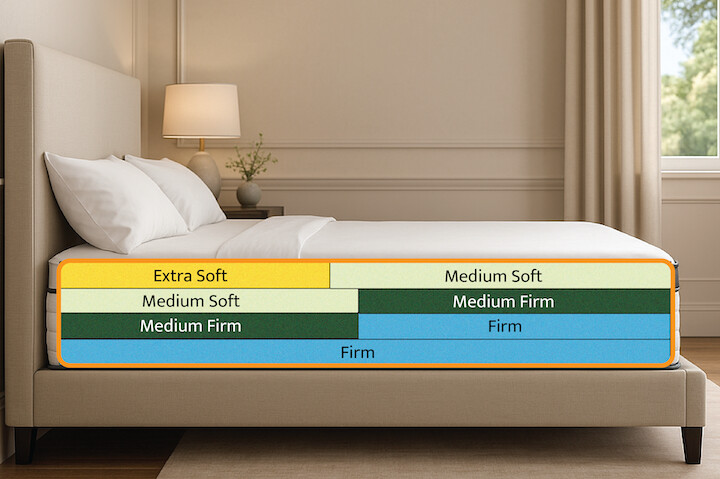
We did try all of those. I originally had layered bottom to top firm, firm, medium inside the mattress cover and 3 inch talalay as a topper on top. I actually made an excel spreadsheet to track what I tried. What I have now has been a lot better for 3 days, we’ll see how it goes. I have bottom up Firm dunlop, medium dunlop, soft talalay with no mattress cover on top. All three inch layers. On top of that I have a padded mattress cover ( I had for my previous mattress) king size but doubled over on my side only and pulled 1/3 of the way down to expose the shoulder area. On top of that I have a 1 inch talalay layer doubled over into the shoulder area, but as a single layer going down toward the foot of the bed. This has let my shoulder sink in more and the mattress pad helps keep my hip from sinking too much.

If it continues to help I am going to cut and assemble an upper layer maybe from part dunlop soft and part soft talalay, to add zoning similar to what I currently have created. I’ve been dealing with this for over a year but I hope to fix it. Really didn’t want to go mattress shopping again.

Thanks for your reply.

1 Like

hope you figure it out. I don’t know your budget, but your description made me think that this place might be a good fit for you, check out the photo of what they provide and here is their link: How It Works | Custom Sleep Technology, Inc.

1 Like

Yes, @CST offers a highly sophisticated combination of options for pinpointing comfort, pressure relief, and adjustability. That’s not to say other latex manufacturers like @Sleep_EZ can’t deliver a comfortable solution. They are true professionals and very skilled at long-distance consultations, with a strong track record of getting it right.

@CST, on the other hand, has a uniquely focused system. You can give them a call. They offer a generous, no-charge consultation to help guide you toward a very comfortable setup using their very individual and customizable approach.

All the best,
Maverick

Thanks Amma and Maverick. We looked them up and it seems like a good system. We have about $2800 in our mattress just over a year old. I think we will try to zone it similar to what CST shows. Could probably get close with buying just 2-3 layers. If it doesn’t work out we could look closer at the CST mattress.

I appreciate the link to CST. I haven’t seen that approach to layering anywhere else. Really like the computer analysis.

2 Likes

Same here. It’s genius. I never thought of doing that.

1 Like

@FloBeds @CST and Obasan Grand are the custom all latex brands that I have looked at.
Flobeds is all natural latex, CST is blended but with precise ILDs and Obasan is all natural Dunlop. The Obasan Grand is at @TheCleanBedroom and is exquisite but over $8,500.

In any case I am torn between flobeds, cst and sleepez 13”.

Early customer support analysis (pre-sales)
1/ @TheCleanBedroom is simply amazing with extreme care in their showroom.
2/ Bob at @CST is very very responsive site and patient. Their website is from the 90s but seem to have a compelling product. If you can get past the site and lack of good info, deal with them over email.
3/ Sleepez and LMF very responsive.
4/ Flobeds responded initially and then stopped responding. Pretty bad sign for potential after sales support.

I wish CST was all natural and I would buy it immediately.

From what i read by arizona mattress factory, the blending gives the best of both worlds. So it helps with durability is what they said.