Please discuss an all latex triple layer mattress like the ones from Custom Sleep design in CT versus a high quality innerspring mattress with a 3" latex top like made at company like Norwalk Mattress in CT. Also to try to save money if you have a good quality 15 year old mattress in good condition ie flat , no sags, can you buy a top quality latex topper from a company like Custom Sleep design to improve your comfort level and will you get 5 to 10 years of good use from this 600 dollar topper.
Hi pbwain,
The answers to your questions are fairly complex in terms of technical issues but they really boil down to personal preferences and feel.
There is really no “standard” type of feel for an all latex mattress because there are so many interacting variables of different ILD’s, different layer thicknesses combinations and firmness levels, latex types, and different ticking/quilting combinations that can have a big effect on the mattress that a 3 layered latex mattress can have a very wide range of different feels and interact very differently with different people. In addition to this … a zoned design will react differently than a latex mattress that doesn’t have this type of zoning. Zoning possibilities may seem very simple but they are deceptively complex in how they can function and in how the areas of zoning and the relative firmness levels of the zoning work together (and even overlap). The “value” of this type of construction is in the ability of the zoning choices to “custom fit” a mattress to each person’s body shape and sleeping style in ways that are much more difficult with unizone layers. Of course this type of customization and exchange possibilities also comes with a price.
In the same way … there are an almost infinite number of variations in innersprings that each create very different types of performance and interactive qualities of a particular mattress. These include the number of coils, the turns of the coil, the height of the coil, the gauge of the coil, and the different methods of joining the coils together. Different shapes also make a big difference (giving a multiple compression rates rather than the more linear compression rate or “spring rate” of a cylindrical coil). There are also “coil in coil” versions (which function in “parallel” in terms of how they compress which adds firmness when the coils compress together) and coil on coil (which function in “series” in terms of how they compress and adds “travel distance” to each coil). There are also many variations of insulator layers or flexolator layers and zoning layers that can be used on top of a coil in addition to coil zoning itself which can alter their properties significantly .
There is a technical spec for foam which is called compression modulus which is the ratio between the force needed to compress a foam to 25% and the force needed to compress the same layer to 65% of it’s thickness. 65% is exactly 2.6 times 25% which means that a completely linear compression rate would have a compression modulus of 2.6. This is approximately the compression modulus of Talalay latex.
Springs have a similar measurement called spring rate. Because they are linear … a single spring which has the shape of a cylinder and has even turns will have an equivalent spring rate of 2.6 (because it would be compressing 2.6 times as far). This means that the compression modulus of Talalay and the spring rate of a cylindrical spring would be similar. dunlop has a higher compression modulus so it would get firmer faster than this same type of spring … but this is where the similarities end. Most springs have a softer section and a firmer section (which can be achieved with different shapes such as thinner and thicker diameters in parts of the spring or different gauge springs on top of each other and in other ways as well). This means that this type of spring would have multiple spring rates. You can see some graphs of the response of variable rate springs here and here. You can also see a typical compression curve of Talalay latex here.
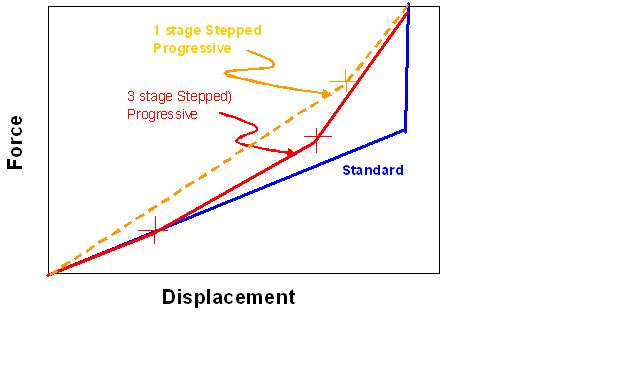
This would in some ways be similar to say a 5" layer of firm latex (like the firm part of the spring) with say an inch or two of softer latex on top of it (like the softer part of the spring). This would then be the “base” for all the layers above it. When you have a layer of softer latex in the middle of a mattress and then firmer layers above it … the firmer layers “dominate” the softer layers and will “bend” into their compression rather than taking up the compression themselves. You don’t often see this in a latex mattress which usually has progressive layers of firmness. this type of layering can feel be firmer on top but still retain the ability to allow the heavier parts to sink down into the mattress. Sinking down into softer layers below has a different “feel” from sinking into upper layers that compress rather than “bend”
In addition to this … latex and all foams have a quality called “hysteresis” which is the ability to absorb energy. Latex has a hysteresis of around 20% to 30% which is the amount of energy absorbed. Innersprings retain almost all their energy and so will “bounce back” or “push back” much more strongly but this is also affected by the type of materials that are used over the innerspring. The “opposite” of hysteresis is resilience which is the height of the rebound a material gives when a ball is dropped on it expressed as a percentage. Innersprings have a higher resilience than latex. This means that an innerspring mattress will be more “springy” than latex or other foams and those who have tried both will validate that the feel between them and how they each react to motion is very different. Some prefer one while other prefer the other. Both can make high quality support layers.
Finally there is a property called point elasticity" which is the ability of a material to compress without affecting the areas beside it. Latex has a very high point elasticity which means it can take on the shape and profile of a body on it very effectively and is very adaptable. Because of it’s elasticity … there are millions of points that can compress individually and which only affect small areas around it. Innersprings on the other hand have less “point elasticity”. Their ability to take on a body shape and isolate motion is more limited to the number of coils and how the coils are connected to each other. Pocket coils with a high coil count would be the most “point elastic” of the innerspring types.
All of this can also be modified by the layers both above and below a particular component or material.
There are other differences as well that are connected to the nature of foam (things like “creep”, airflow and temperature regulation and many others) but in terms of performance these are the general differences.
There are so many differences between them that it is really impossible to answer these types of “apples to oranges” questions in any other way than through very general comparisons that may not represent the differences between two specific mattresses. There are those whose “ideal” mattress is latex over innersprings for example and not only that, it may be a particular type of innerspring. There are others who will only sleep on all latex and even then they may have strong preferences to a certain type of latex in some of the layers (Dunlop latex for example has a compression modulus that is around 4 but because of a different cell structure is also less “springy” feeling so it really does get firmer faster and this also gives the mattress a different feel and performance characteristics).
In essence … all mattresses boil down to what I call PPP which is their Pressure relieving qualities (that comes from the pressure relieving cradle that they form which spreads weight out over the mattress surface), the Posture and alignment qualities (this is the ability of a mattress to “allow” your wider lighter areas like shoulders to sink in enough while “stopping” the heavier narrower areas like the pelvis from sinking in too far) which keeps your spine in alignment in all your sleeping positions, and the Preference qualities (which are things that are more subjective or preference based like springiness, energy absorption, breathability, being more “on” or “in” the mattress, the surface or “hand” feel of the mattress, motion isolation, slower or faster response, and others).
So there are many complex differences even within each category much less the differences between an innerspring and a latex support layer that the best way to decide is to make sure that they both provide the pressure relief and alignment you need and then everything else after that is preference and the relative “value” of each material compared to the price of the mattress. In general innersprings are less costly than good quality latex.
This would depend entirely on whether the materials in the mattress had softened which is much different than actual sags that are visible. It would also depend on the relative firmness of the layers on top of the mattress and what you were adding to it. For example if your mattress already has 4 or 5" of soft foam on top … then adding more soft foam would carry the risk of sleeping out of alignment. If the mattress was too firm, then adding a topper would be a good way to make it softer and more pressure relieving. In this case “just enough” in terms of softness and thickness is usually best.
So how well a topper would work would depend on the degree of wear and softening of the various areas and layers of the mattress, on the effect you were trying to achieve (toppers are a good way to add pressure relief but much more risky as a way to improve alignment) and on the layering and materials that the topper was going on.
If you use a good quality topper (like latex) and add it to a mattress that is still in “new” or “near new” condition … then it would certainly be reasonable to expect a lifespan of 5 - 10 years for the topper but this may not be the length of time that the combination of mattress and topper will be effective for you. This would depend on the “weak link” of the entire sleeping system you were using (which is generally any lower quality/density polyfoam over the innerspring rather than the springs or the latex topper). While it certainly could improve your comfort level (pressure relief) and even the “feel” of the mattress (if you prefer the feel and properties of latex comfort layers) … it may not necessarily improve the ability of the mattress to keep you in alignment which would depend on all the other layers and how they interacted with your body shape, weight, and sleeping positions.
Hope this helps … such a long answer to such a short question and it really boils down to a matter of preference 
Phoenix
1 Like
Thank you for your response, we are going to speak with Bob at CSD on wednesday.
1 Like
If Branford isn’t too far for you you can lay on both types at Comfort Sleep Systems. They have a Hy’Bed which is a Latex over innerspring core mattress on their showroom. Their all latex mattress is pretty nice too, but is not the same as CSDs “zoned” and left/right layered approach. They do have an all latex left/right mattress available but it runs a similar price to the CSD mattress… and I don’t beleive it is “zoned”.